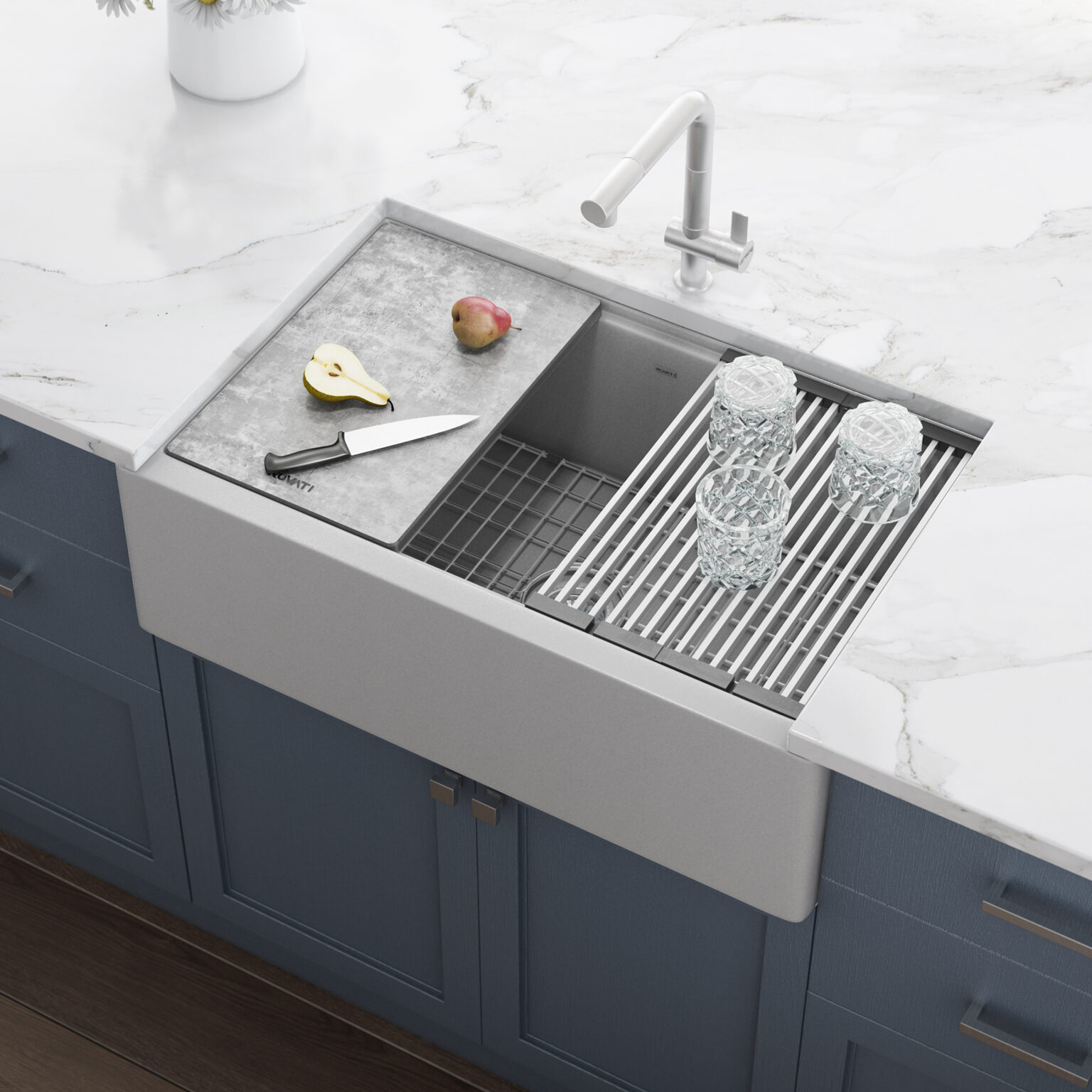
Here at Ruvati, we sell a number of different bathroom and kitchen products. We have a kitchen faucet product range, amongst others.
If you are looking to buy a kitchen faucet but aren’t sure how to make your decision, don’t worry. We’ve created this guide for our customers, as well as for the general public, so that everyone can understand the important factors that need to be considered before you make your purchase.
In this guide, we’ll mention the various factors and components of a faucet that you need to consider. At the bottom of each section, we’ll describe how to make your choice based on your needs and requirements.
Before we jump into that detailed guide, we’ll also provide the essential information in a concise, short guide.
Let’s get started.

Concise, Short Kitchen Faucet Buying Guide
In this brief guide, we’re going to quickly mention the key factors you should consider when buying a kitchen faucet, along with why each one matters.
This overview is meant to give you a clear snapshot of what influences performance, compatibility, and long term satisfaction, before you move on to the detailed explanations below.
- Faucet type: Determines how water is delivered and how convenient the faucet feels during everyday kitchen tasks
- Installation style: Affects compatibility with your sink, countertop, and existing plumbing layout
- Spout height, reach, and swivel angle: Control clearance, water placement, and how freely the faucet moves during use
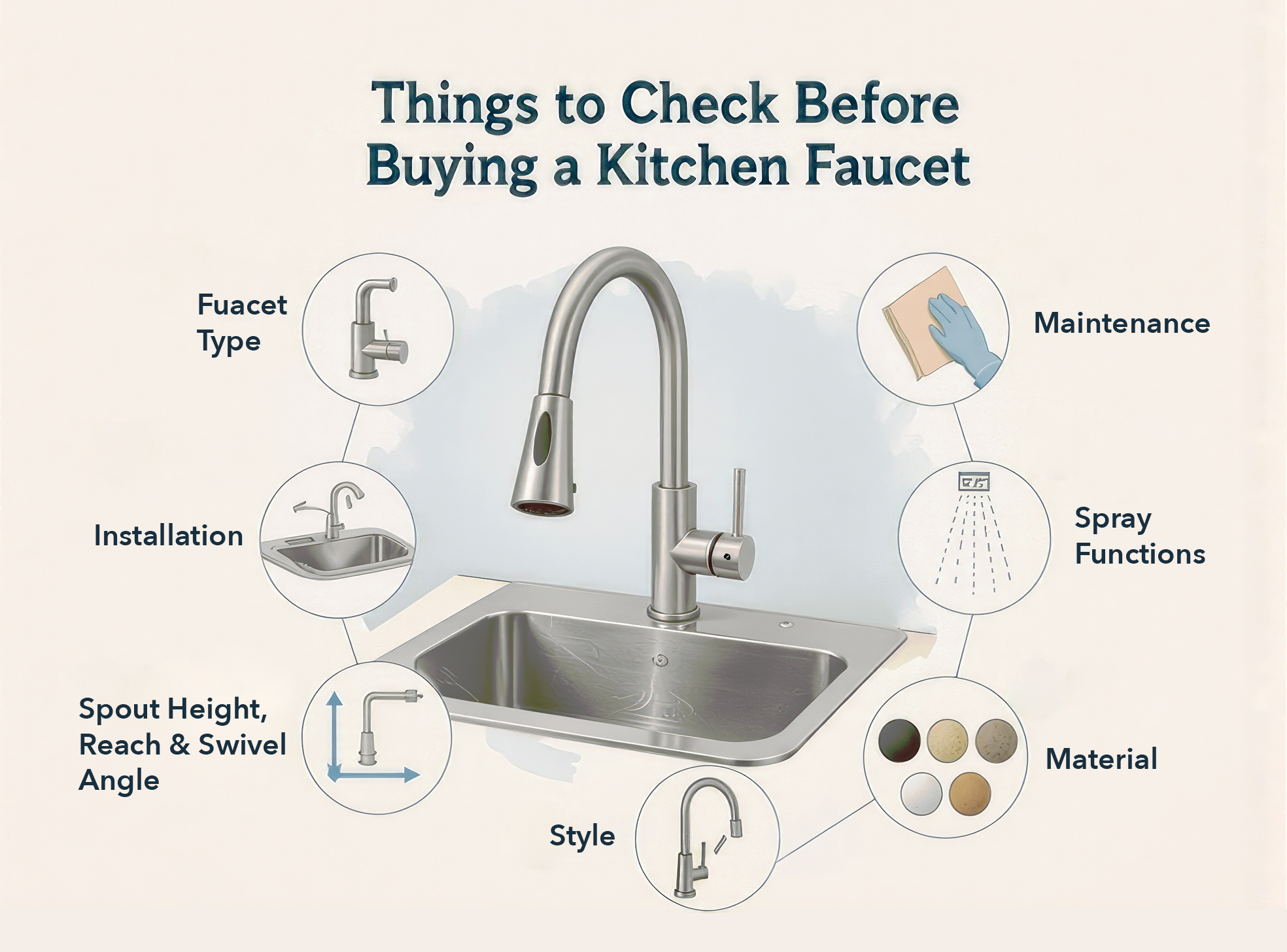
- Style and aesthetic: Influence how well the faucet fits into the overall kitchen design
- Finish and color: Define surface appearance and how the faucet visually coordinates with surrounding elements
- Material: Impacts durability, corrosion resistance, and expected lifespan
- Spray function and modes: Determine how adaptable the faucet is for rinsing, cleaning, and food prep
- Ease of maintenance: Affects how much time and effort is needed for routine cleaning and upkeep
By reviewing these points first, you’ll have a practical framework for evaluating your options. The full guide below expands on each factor in detail, helping you make a well-informed purchase that suits your kitchen and your daily needs.
Long, Detailed Guide: Understanding the Essentials of Kitchen Faucets and How to Choose Them
Here is a list of the various essentials that must be considered when choosing a kitchen faucet.
- Faucet type
- Configuration
- Installation style
- Spout height, reach, and swivel angle
- Style and aesthetic
- Finish and color
- Material
- Spray function/modes
- Ease of maintenance
Let’s go into detail for each of them to give a proper explanation.
1. Faucet Type
The faucet type refers to the overall functional design of the faucet and how water is delivered during everyday use. This is one of the most important decisions because it directly affects convenience, workflow, and long-term satisfaction.
Kitchen faucets are available in several common types, each suited to different kitchen layouts and usage habits.
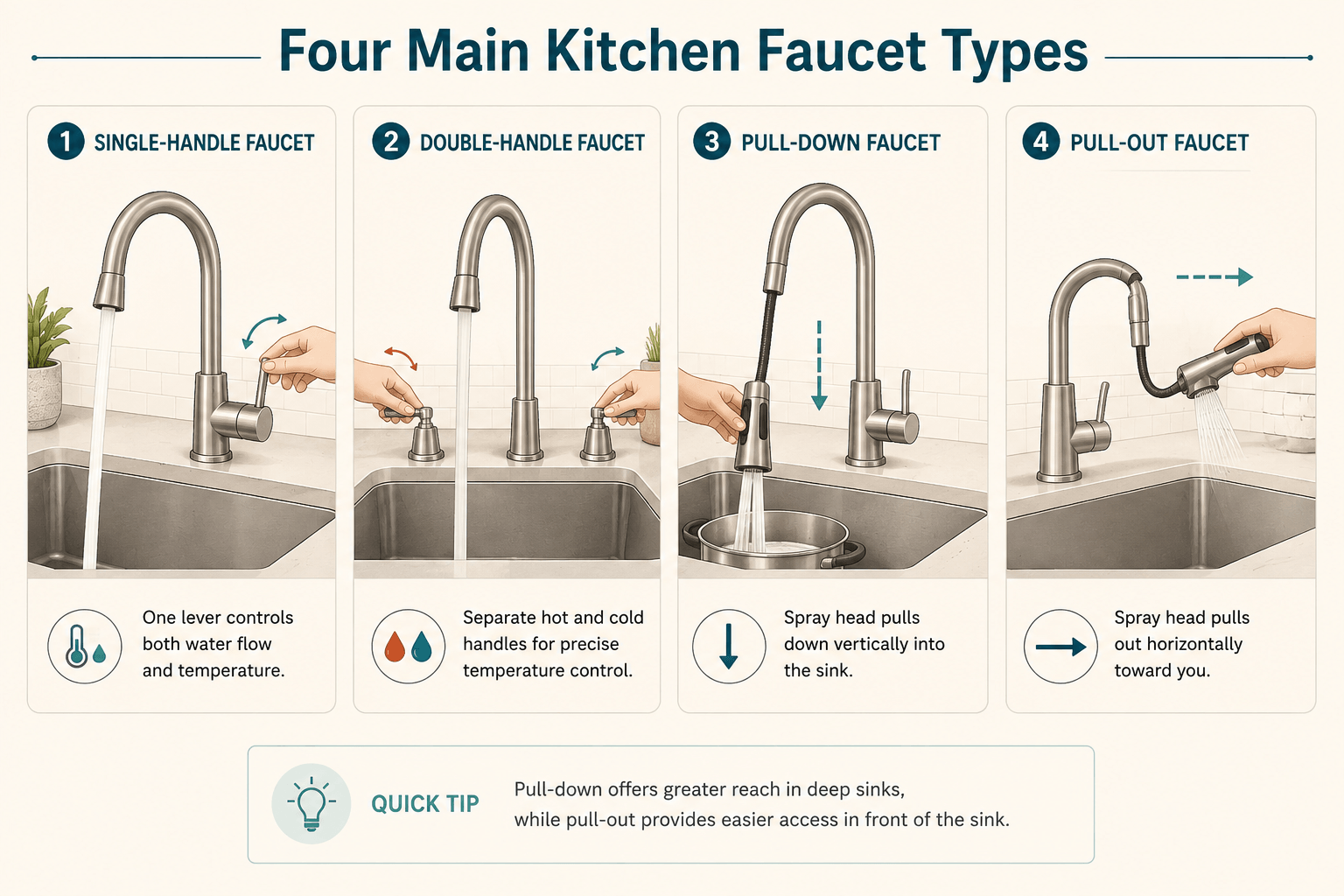
Single-handle faucets
These use one lever to control both water temperature and flow. They are easy to operate with one hand and are ideal for busy kitchens where quick and swift use is needed. Their simple design also makes them visually uncluttered and quite easy to clean.
Double-handle faucets
These have separate handles for hot and cold water. They offer more precise temperature control and are often chosen for traditional or classic kitchen designs. However, they usually require more space and slightly more effort during use.
Pull-down faucets
These feature a tall spout with a spray head that pulls straight down into the sink. They are especially useful for deep sinks and large cookware, making rinsing and cleaning more efficient. Pull-down faucets are commonly seen in modern and professional-style kitchens.
Pull-out faucets
With a shorter spout and a spray head that pulls outward toward the user, pull-out faucets work well in smaller kitchens or shallow sinks. They offer flexibility without requiring much vertical clearance. Where a pull-down faucet is extracted vertically, a pull-out faucet is extracted horizontally.
How to Choose the Right Faucet Type for Your Next Purchase?
In order to choose the right faucet type, you need to consider the following factors:
- Kitchen workflow needs: Consider how you typically use your sink, frequent pot washing, food prep, or light rinsing will favor different faucet types.
- Sink configuration: The number of bowls and their size affect which faucet type feels most natural during use.
- User interaction style: Some users prefer quick, one-motion control, while others are comfortable adjusting separate handles during tasks.
- Range of motion required: Think about how often you need to move water direction. Flexible spray-based faucet types support more dynamic tasks.
- Vertical versus horizontal movement preference: Decide whether pulling the spray head downward or outward feels more intuitive for your daily routine.
- Shared household use: If multiple people use the kitchen, choose a faucet type that feels easy and intuitive for all users.
Intended longevity of choice: Faucet type impacts daily comfort for years; selecting a design that aligns with long term habits is more important than short term trends.
2. Installation
Installation refers to how and where the kitchen faucet is mounted. Understanding installation details is essential because they determine compatibility with the sink, countertop, and plumbing setup.
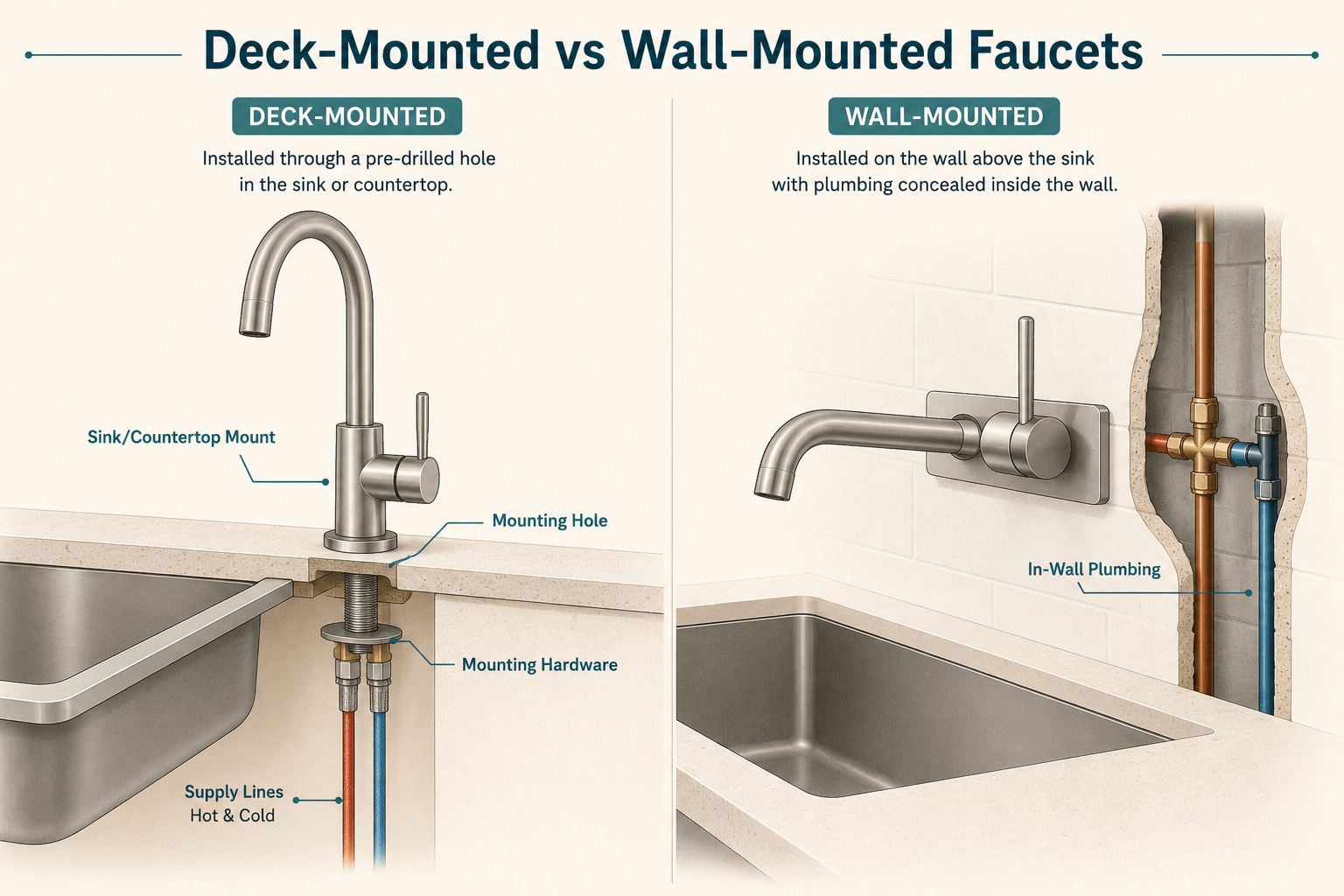
Germane to installation, there are two types into which faucets are divided. They are:
Deck-mounted faucets: Deck-mounted faucets are installed directly onto the sink or countertop. This is the most common installation type in residential kitchens. The faucet base passes through pre-drilled holes and is secured from underneath the sink deck.
Wall-mounted faucets: Wall-mounted faucets are installed into the wall above the sink rather than on the sink or countertop. The plumbing connections are concealed behind the wall, and the spout extends outward over the sink basin. This installation style requires precise placement and wall plumbing alignment.
How to Choose the Right Installation Style for Your Faucet?
In order to choose the right installation style for your new faucet, you should consider the following:
- Existing plumbing setup: Most kitchens are already configured for deck-mounted faucets, while wall-mounted options require in-wall plumbing.
- Sink and countertop design: Pre-drilled holes naturally support deck-mounted installations, and solid backsplashes can accommodate wall-mounted styles.
- Renovation scope: Wall-mounted faucets are easier to plan during full remodels, while deck-mounted faucets fit simple replacements.
- Placement precision: Wall-mounted installations demand accurate height and reach alignment to avoid splash issues.
- Visual preference: Deck-mounted faucets blend into traditional layouts, while wall-mounted styles create a cleaner, more architectural look.
3. Spout Height, Reach, and Swivel Angle
Another important factor to consider when buying a kitchen faucet is spout height, reach, and swivel angle.
These design dimensions decide how far the faucet extends over the sink and how freely it moves during use. They influence clearance, water placement, and overall functionality.
Spout height: Spout height is measured from the base of the faucet to the outlet where water flows. Some faucets have a low-profile spout that stays close to the sink, while others feature a high-arc or gooseneck design that provides more vertical clearance.
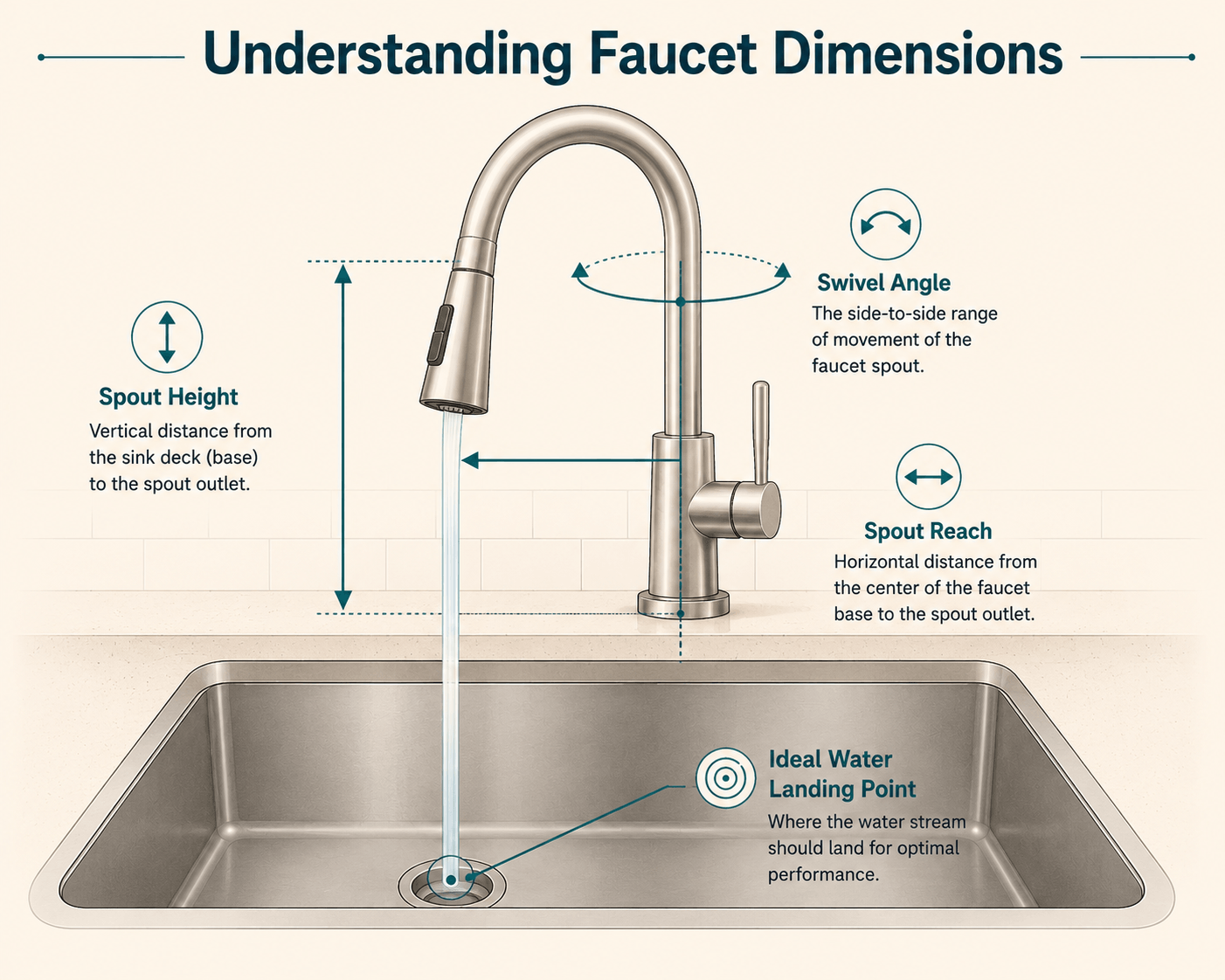
Spout reach: Spout reach refers to the horizontal distance from the center of the faucet base to the water outlet. This measurement determines where water lands in the sink basin. Proper reach ensures water flows into the center of the sink rather than too close to the back or edge.
Swivel angle: The swivel angle indicates how far the spout can rotate from side to side. Common swivel ranges include 90, 120, 180, or full 360-degree rotation. This movement is especially relevant for double-bowl sinks or sinks used for multiple tasks.
| Dimension | Common Range | What It’s Best For |
|---|---|---|
| Spout Height | 3 to 8 in (75 to 200 mm) | Low-profile faucets. Shallow sinks. Tight vertical clearance. |
| 8 to 10 in (200 to 250 mm) | Standard kitchen use. Works with most single-bowl sinks. | |
| 10 to 16+ in (250 to 400+ mm) | High-arc or gooseneck designs. Easier pot filling. Better clearance for large cookware. | |
| Spout Reach | 6 to 8 in (150 to 200 mm) | Small sinks or compact countertops. Keeps water controlled. |
| 8 to 10 in (200 to 250 mm) | The practical sweet spot. Centers water in most single-bowl sinks. | |
| 10 to 12+ in (250 to 300+ mm) | Wide or farmhouse sinks. Prevents splashing near the back wall. | |
| Swivel Angle | 90° | Minimal movement. Fine for simple, single-task setups. |
| 120° to 180° | More flexibility without over-rotation. Ideal for single-bowl sinks. | |
| 360° | Maximum freedom. Perfect for double-bowl sinks and multitasking. |
How to Choose the Right Spout Height, Reach, and Swivel Angle
Here are some factors to consider in order to choose the perfect spout dimensions and angle.
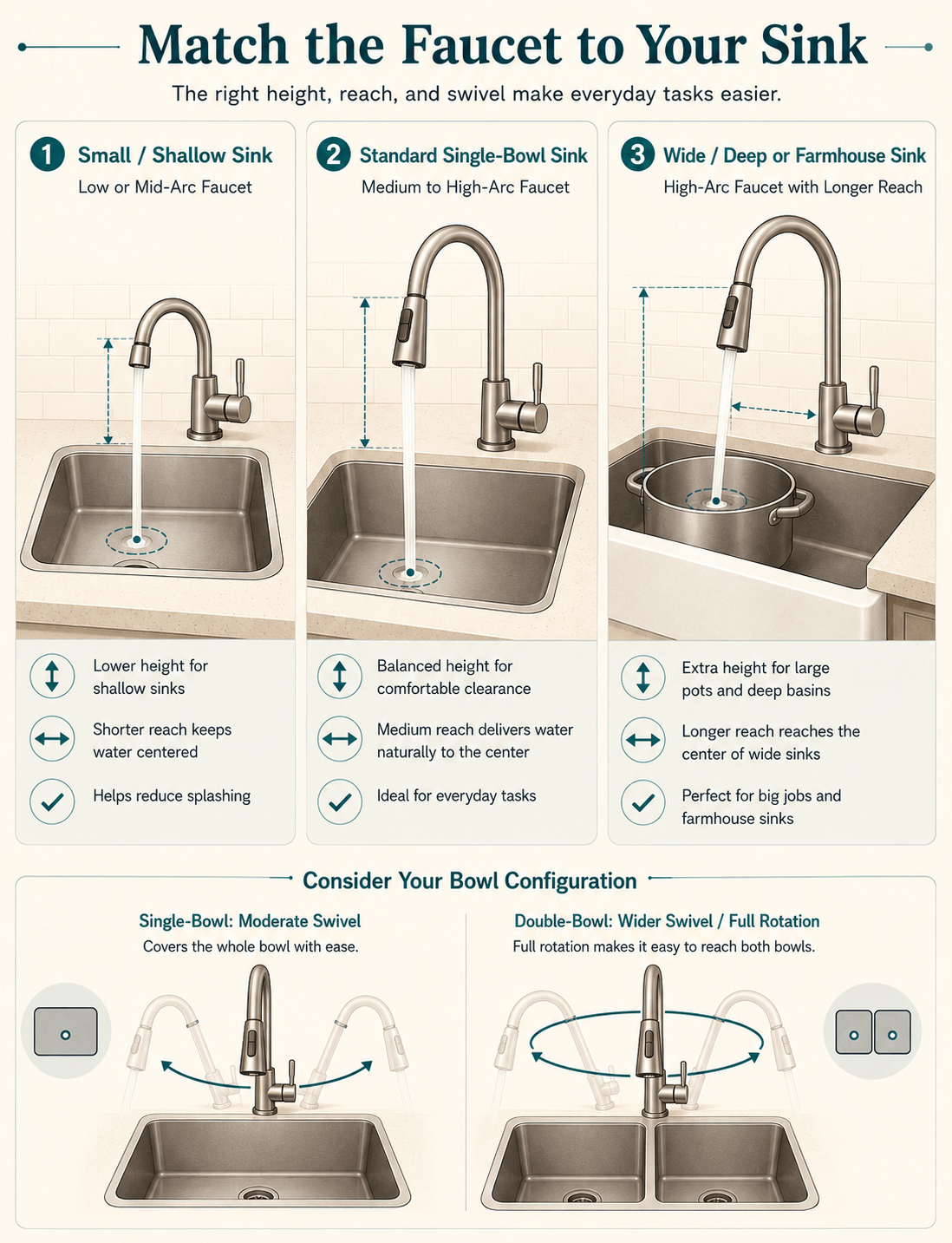
- Sink depth and size: Deeper or wider sinks benefit from taller spouts and longer reach, shallow sinks work better with lower profiles.
- Cabinet and backsplash clearance: Limited vertical space above the sink favors low or mid-arc spouts to avoid interference.
- Water landing position: Choose a reach that directs water toward the center of the basin to reduce splashing during use.
- Number of sink bowls: Double-bowl sinks require wider swivel angles to move water efficiently between basins.
- Primary kitchen tasks: Frequent pot filling and large cookware handling feel easier with high-arc spouts and broader swivel ranges.
- Control and stability preference: Some users prefer a restricted swivel for precision, others value full rotation for flexibility.
4. Style and Aesthetic
Style and aesthetic describe the visual character of the kitchen faucet and how it fits into the overall kitchen design. While performance determines how a faucet functions, its appearance plays a key role in how the space feels as a whole.
Design style categories
Kitchen faucets are commonly grouped into styles such as modern, traditional, transitional, industrial, and farmhouse. Each style is defined by distinct shapes, proportions, and detailing, ranging from clean lines and minimal ornamentation to more decorative forms.
Spout and handle styling
The shape of the spout, whether straight, curved, angular, or arched, contributes significantly to the faucet’s visual identity. Handle design also varies, from sleek levers to cross or knob-style handles, reinforcing the overall aesthetic.
Here is a table that describes each design style:
Kitchen Faucet Design Styles
| Design Style | Visual Characteristics | Typical Kitchen Fit |
|---|---|---|
| Modern | Clean lines. Minimal detailing. Flat or cylindrical forms. | Contemporary kitchens. Handleless or slab cabinetry. |
| Traditional | Decorative curves. Classic proportions. Ornate accents. | Classic or vintage kitchens. Raised-panel cabinets. |
| Transitional | Balanced mix of modern simplicity and traditional warmth. | Versatile layouts. Works across most kitchen designs. |
| Industrial | Exposed structure. Bold geometry. Utility-driven look. | Loft-style or urban kitchens. Mixed materials. |
| Farmhouse | Soft curves. Substantial presence. Simple but warm detailing. | Farmhouse and country kitchens. Apron-front sinks. |
Spout and Handle Styling
| Component | Style Type | Visual Effect and Use |
|---|---|---|
| Spout | Straight | Sharp and modern. |
| Curved | Softer appearance. Works well in traditional and transitional kitchens. | |
| Angular | Bold and architectural. Common in modern or industrial designs. | |
| Arched / Gooseneck | Tall and flowing. Adds visual height and functional clearance. | |
| Handle | Lever | Sleek and ergonomic. Fits modern and transitional styles. |
| Cross | Classic and decorative. Reinforces traditional aesthetics. | |
| Knob | Compact and subtle. Common in vintage-inspired designs. | |
| Dual-handle | Symmetrical and formal. Traditional look with precise control. |
How to Choose the Right Style and Aesthetic for Your Kitchen Faucet
Start by looking at the dominant design language of your kitchen. Cabinet style, countertop material, sink type, and lighting fixtures should all feel visually aligned with the faucet, so the space appears cohesive rather than pieced together.
After that, focus on proportion and visual balance. The spout shape and handle design should complement the scale of the sink and surrounding elements, creating a focal point that feels intentional without overpowering the rest of the kitchen.
5. Finish and Color
Finish and color define the surface appearance of the kitchen faucet and influence how it interacts visually with other elements in the kitchen. These characteristics affect reflectivity, texture, and how the faucet ages over time.
Common faucet finishes: Kitchen faucets are available in a wide range of finishes, including chrome, stainless steel, brushed nickel, matte black, brass, and bronze. Each finish has a distinct surface treatment that determines whether it appears glossy, satin, or matte.
Color variation and undertones: Some finishes have warm undertones, such as brass and bronze, while others have cooler tones, such as chrome and stainless steel. These undertones influence how the faucet coordinates with cabinet hardware, sinks, and appliances.
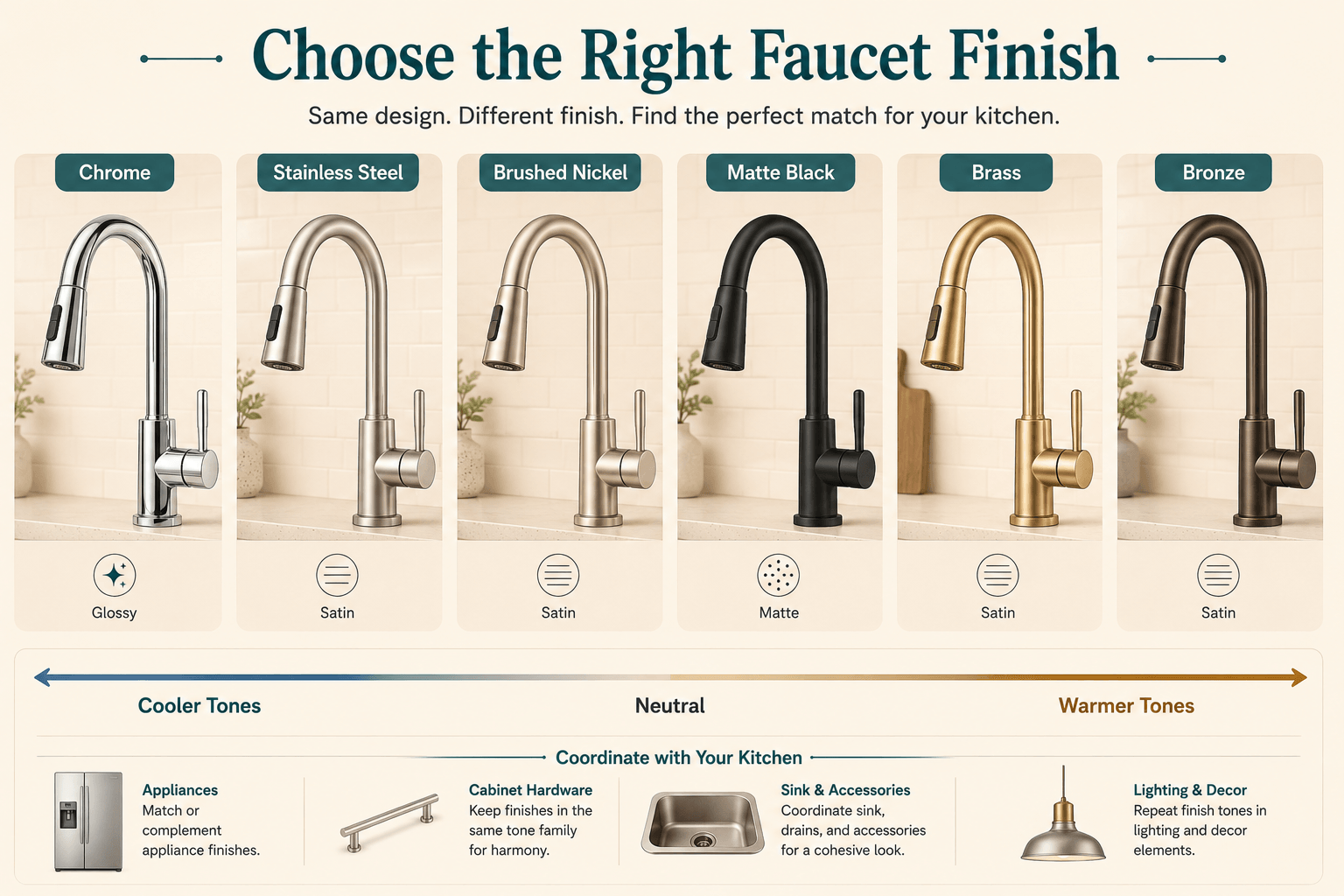
Surface treatments and coatings: Many finishes are achieved through specialized coating processes that enhance appearance and protect the underlying material. These treatments affect resistance to fingerprints, water spots, scratches, and corrosion.
How to Choose the Right Finish for Your Kitchen Faucet?
As far as finishes go, the deal is more or less the same as what we mentioned in style and aesthetics. You have to assess your existing space and then make a choice that doesn’t overwhelm the aesthetic.
6. Material
Material refers to the substances used to manufacture the faucet body and its external components. The material directly affects strength, durability, resistance to corrosion, and overall lifespan.
Brass
Brass is one of the most commonly used materials for high-quality kitchen faucets. It is strong, resistant to corrosion, and well-suited for long-term exposure to water. Solid brass construction is often associated with heavier, more durable faucets.
Stainless steel
Stainless steel faucets are valued for their resistance to rust and staining. They maintain their appearance well over time and are less prone to corrosion caused by moisture or cleaning agents.
Zinc alloy
Zinc alloy is sometimes used in more budget-friendly faucets. It allows for detailed shaping but is generally less durable than brass or stainless steel, especially with prolonged exposure to water.
Composite and mixed materials
Some faucets use a combination of materials, such as a metal body with internal plastic or composite components. These materials can reduce weight and cost while still meeting functional requirements.
Durability considerations
Material choice influences how well a faucet resists wear, mineral buildup, and environmental stress over time. Heavier materials often indicate a more solid construction, while protective coatings help extend service life regardless of the base material.
Here is a table that describes each material in terms of looks, durability, and ease of maintenance.
| Material | Appearance | Durability | Ease of Maintenance |
|---|---|---|---|
| Brass | Solid, premium look. Often paired with high-end finishes. | Very high. Excellent resistance to corrosion and long-term wear. | Easy. Resists rust and handles cleaning well with minimal upkeep. |
| Stainless Steel | Clean, modern appearance. Consistent finish over time. | High. Strong resistance to rust, stains, and moisture-related damage. | Very easy. Non-porous surface reduces spotting and corrosion. |
| Zinc Alloy | Can mimic premium finishes. Lighter visual feel. | Moderate to low. More susceptible to wear and corrosion over time. | Moderate. Requires gentler cleaning to avoid finish degradation. |
| Composite / Mixed Materials | Varies by design. Often indistinguishable externally. | Moderate. Depends on metal-to-plastic ratio and build quality. | Easy. Lightweight components reduce stress but may age unevenly. |
How to Choose the Right Faucet Material
Begin by considering how long you expect the faucet to serve and how intensively it will be used. Heavier, solid materials generally signal stronger construction and better resistance to daily stress in busy kitchens.
Next, think about the environment the faucet will face over time. Water quality, humidity, and exposure to cleaning products all influence how different materials age, making corrosion resistance and surface stability especially important.
Here is a brief recap, if you don’t want to go through the detailed breakdown given above:
- Solid brass offers the highest durability and long-term reliability
- Stainless steel balances strength with a clean, modern appearance
- Zinc alloy suits lighter use and tighter budgets
- Composite builds vary in performance depending on construction quality
- Heavier materials often indicate more robust internal construction
7. Spray Function and Modes
Spray function refers to how water is delivered from the faucet and the different flow patterns available during use. These modes are built into the faucet design and determine how adaptable it is for various kitchen tasks.
We’re going to list the common spray functions/modes below. The more of these a faucet has, the easier and more enjoyable it is to use.
Standard stream: The standard stream provides a steady, concentrated flow of water. This mode is commonly used for filling pots, glasses, and everyday rinsing.
Spray mode: Spray mode disperses water into a wider pattern, increasing coverage across the sink. It is typically used for rinsing dishes, washing produce, and cleaning the sink basin.
Pause or shut-off function: Some faucets include a pause feature that temporarily stops water flow at the spray head. This allows the user to interrupt water flow without adjusting the main handle.
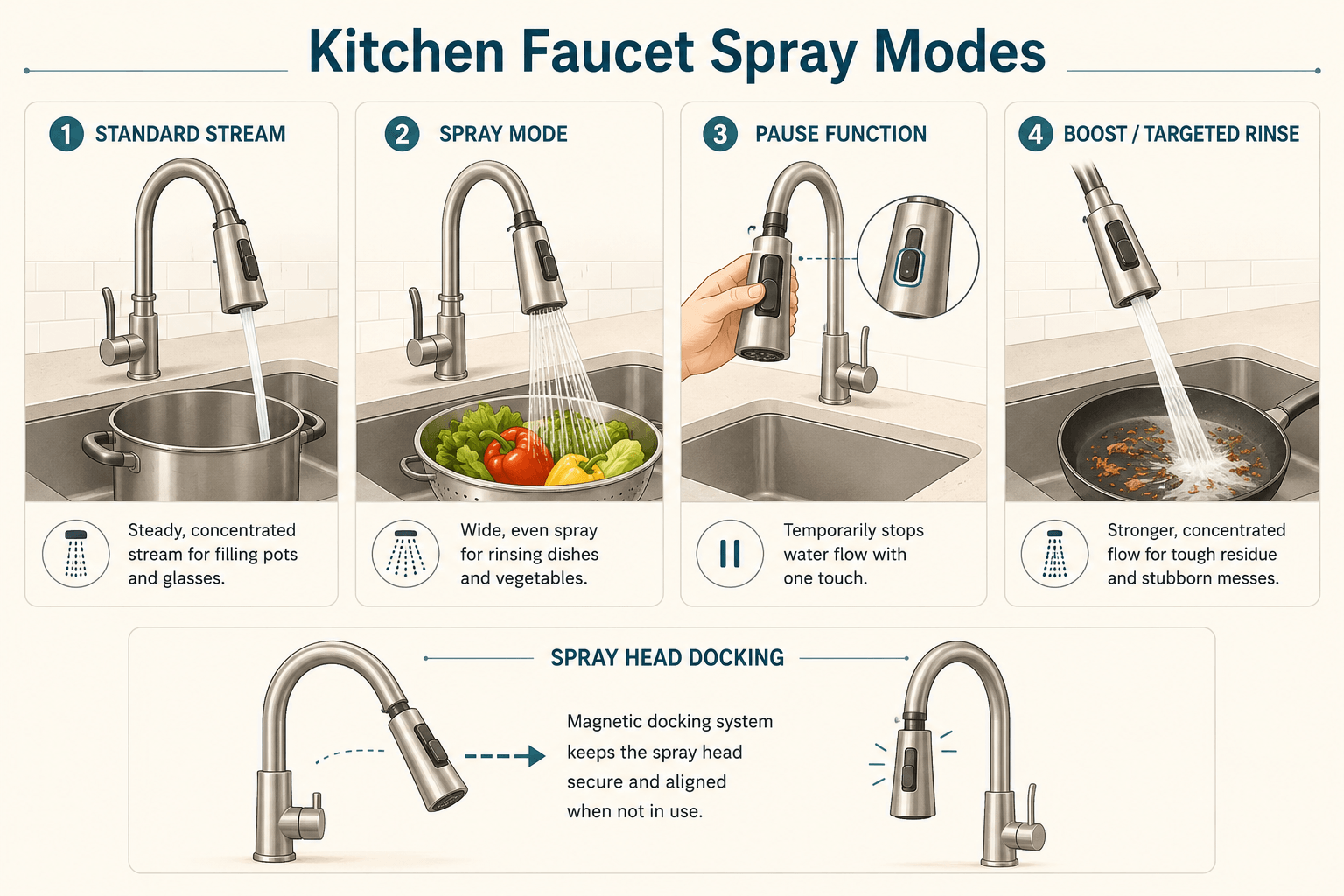
Multiple or advanced spray options: Certain faucets offer additional spray variations, such as boosted pressure or targeted rinse modes. These options are integrated into the spray head and selected using buttons or switches.
Spray head docking: For pull-down and pull-out faucets, the spray head returns to the spout using either gravity or a magnetic docking system. Docking design affects how securely the spray head sits when not in use.
All in all, spray functions and modes define how versatile the faucet is during daily kitchen activities and contribute to overall ease of use.
How to Choose Spray Mode Functions for Your Next Faucet?
As far as the spray modes and functions go, you have to evaluate your usage habits. If your needs are simple and your usage is straightforward, there’s no reason to spend more on a faucet that provides advanced spraying modes.
On the other hand, if you are an avid cook and if you have to spend a lot of time in the kitchen cleaning a whole lot of different items, then it makes sense to invest in a faucet with advanced spraying features.
8. Ease of Maintenance
We mentioned ease of maintenance above, in the section dealing with “materials.” However, there are various other elements in a faucet that define how easy it is to clean and to perform basic upkeep.
We’re going to describe those elements below:
| Element | Why It Matters | Maintenance Impact |
|---|---|---|
| Finish type | Smooth, sealed finishes resist water spots and fingerprints | Reduces cleaning frequency and prevents buildup |
| Spout design | Simple, straight spouts have fewer crevices | Easier wiping and less trapped debris |
| Handle configuration | Single-handle designs have fewer moving parts | Faster cleaning and fewer wear points |
| Cartridge type | High-quality ceramic cartridges resist wear | Less frequent replacement and smoother operation |
| Aerator accessibility | Removable aerators allow quick cleaning | Prevents clogging from mineral deposits |
| Valve construction | Durable internal valves handle pressure better | Lower risk of leaks over time |
| Mounting style | Top-mounted faucets are easier to access | Simplifies installation and future servicing |
| Surface detailing | Minimal grooves or decorative cuts | Limits grime accumulation and scrubbing effort |
How to Factor in Ease of Maintenance When Purchasing Your Next Kitchen Faucet?
If you have the time and ability to clean your faucets on a regular basis, you can go ahead and buy one with a sophisticated design so that you can enjoy the aesthetics.
On the other hand, if you have a busy routine and you don’t feel like you’ll be able to do much other than a quick, occasional wipe down, it’s better to go for something simpler that is not very demanding in terms of maintenance.
Wrapping Up
In order to choose the right kitchen faucet, you have to properly understand the design of your kitchen as well as your daily usage habits. There are a whole lot of different factors that you have to weigh before making your purchase, including the aesthetics, materials, functions, etc., which we have detailed in the guide above.
If you’re looking for a place where you can find high-end and reliable kitchen faucets to browse from, you’re actually already there. Click here to view our collection of kitchen faucets here at Ruvati. If you have any questions to ask before you make a purchase (a question that we weren’t able to address in this guide), you can always get in touch with us.
Thanks for reading!
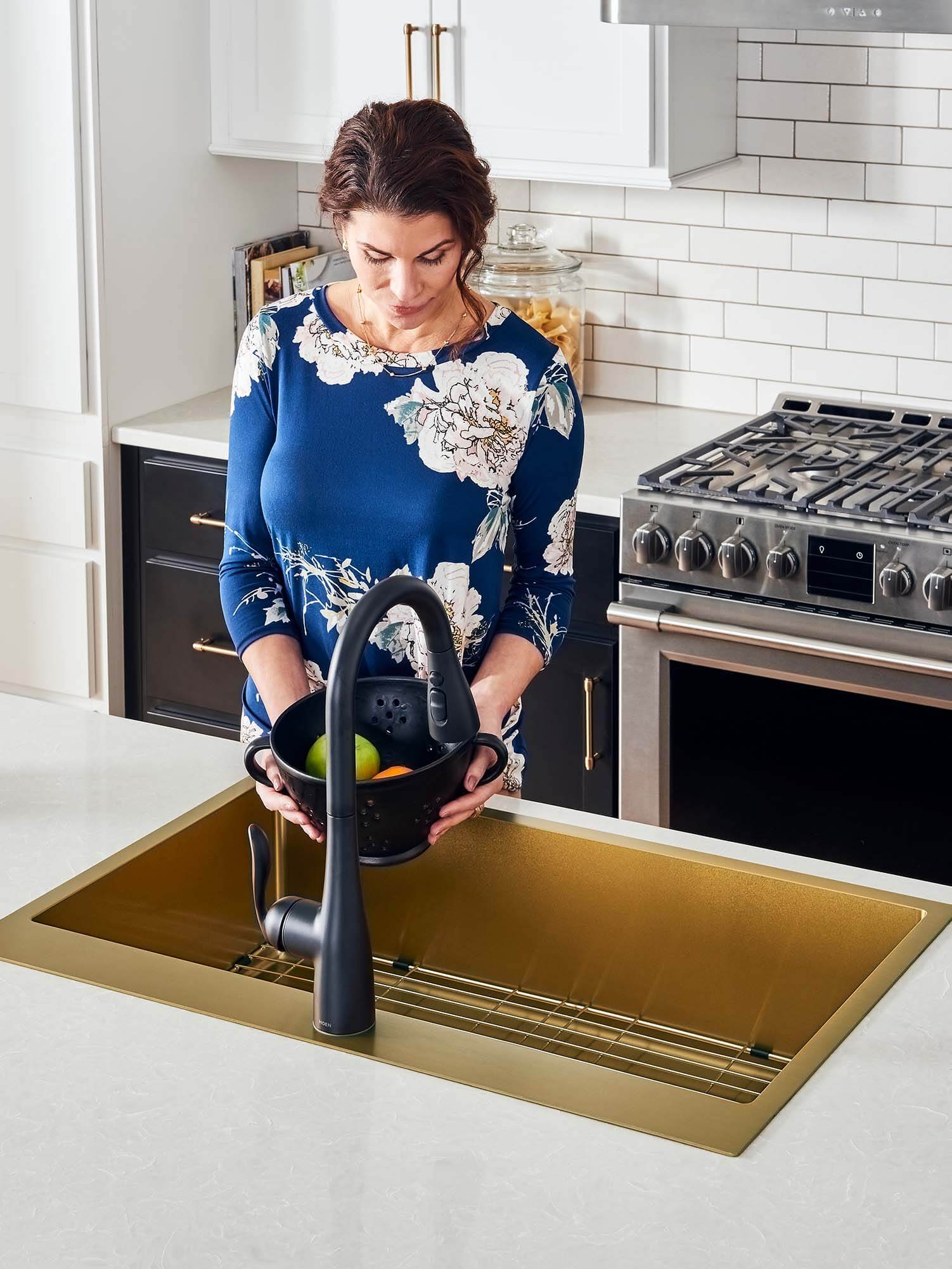
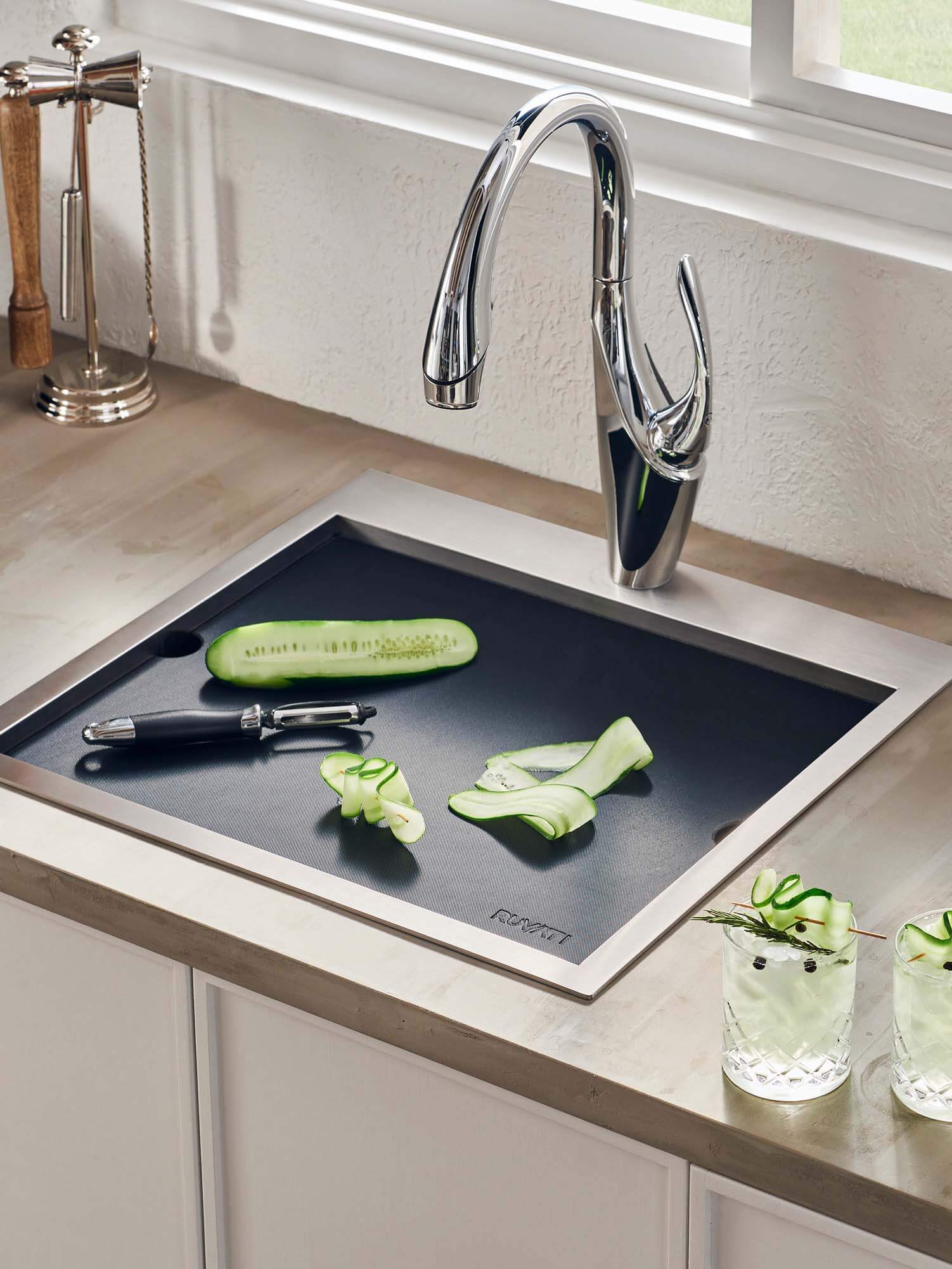
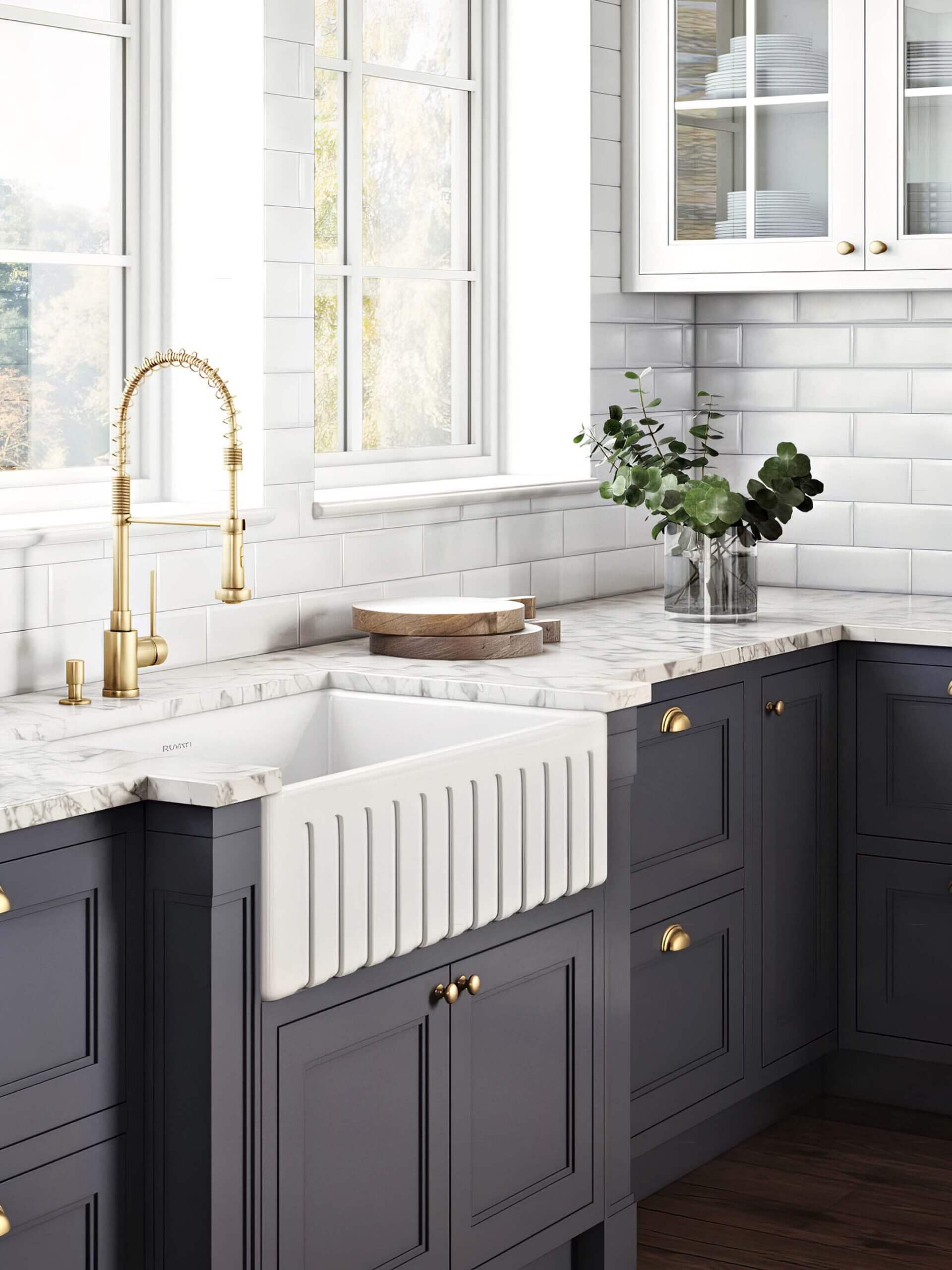
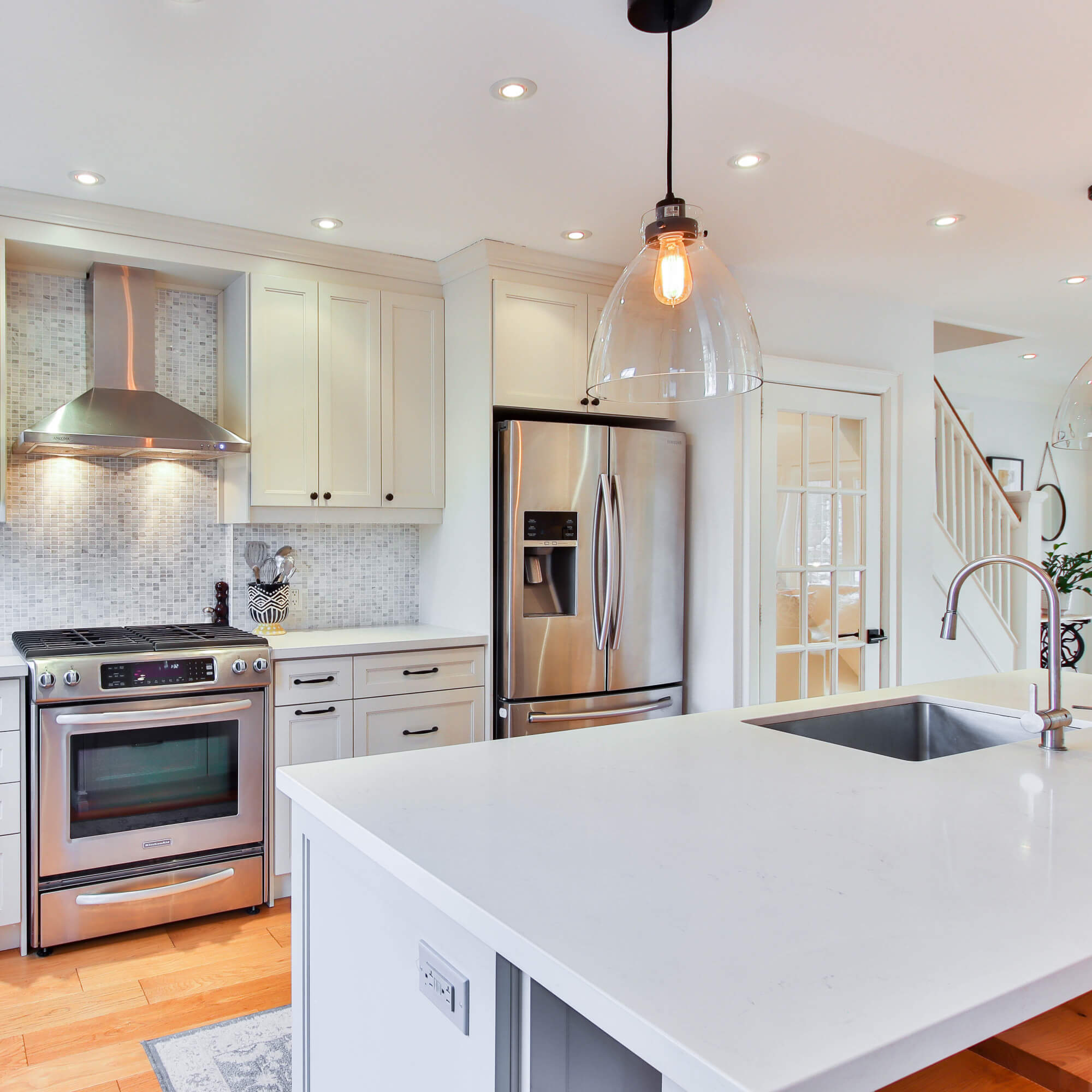

Stainless steel is one of the most durable materials for kitchen sinks. For almost a century, stainless steel sinks have been the sink of choice for American kitchens.