Overview/Summary of Article:
Farmhouse sinks—also called apron-front or farm-style sinks—are loved for their deep basins, ergonomic access, and timeless design, making them ideal for both modern and traditional kitchens.
When choosing one, focus on material, size, style, and appearance. Fireclay is the most durable and low-maintenance, while stainless steel, cast iron, copper, and composites offer different advantages depending on your kitchen style and cleaning preferences. Match the sink size to your base cabinet, typically choosing between 30″–36″, and go for a single bowl if you prefer simplicity, or a double bowl if you often multitask. Choose a finish that either blends with or contrasts your kitchen for the best visual impact.
If you’re short on time for cleaning, stick with smoother materials like stainless steel—they’re far easier to maintain than options like granite or copper. For top picks, Ruvati offers standout farmhouse sinks in 2025—from handcrafted fireclay to stainless-steel workstations and bold matte finishes like gold and gunmetal. Bottom line: choose based on how you use your kitchen, how much space you need, and how much maintenance you’re willing to take on.
Introduction
Farmhouse kitchen sinks are also called apron front, farm style, or farmer sinks. They have earned a top spot in modern kitchen design trends. With their deep basins, stylish exposed fronts, and blend of rustic charm and practicality, they’re not just a trend—they’re a kitchen essential. In this guide, we’re going to help you understand how you can choose the best farmhouse sink for your kitchen, whether you’re doing a remodel or building from scratch.
What Is a Farmhouse Sink?
A farmhouse sink, or farmers sink, features a large, forward-facing front that replaces a section of the countertop. In other words, the sink front juts out of the counterspace, creating extra space in the bowl.
Traditionally, it was designed to handle large pots and pans, which made it perfect for farm kitchens and gave rise to its name. Today, farmhouse sinks in kitchens are both a style statement and a practical choice.
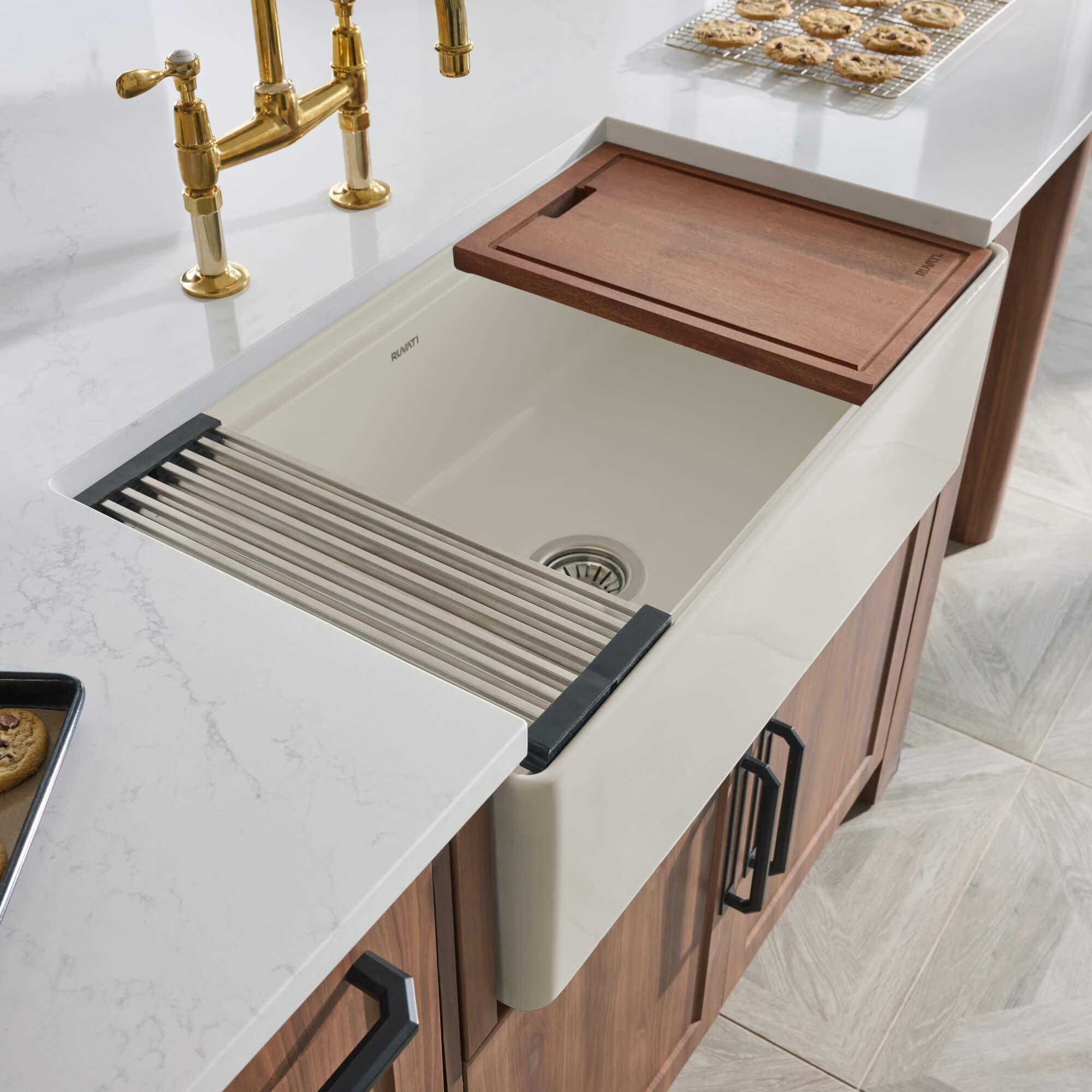
Here is an image of a farmhouse sink to help you understand it better:
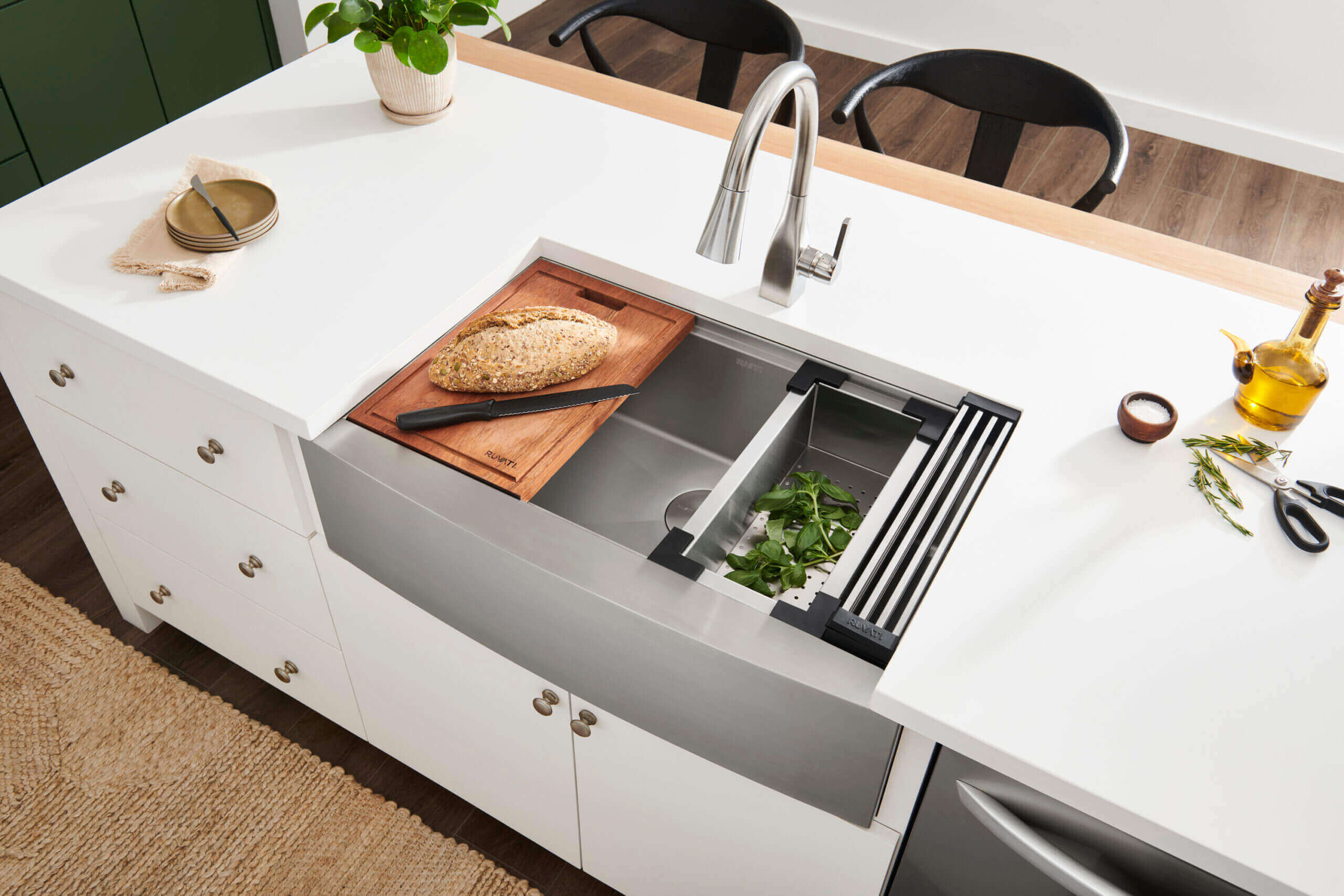
As you can see, for the entire width of the sink, the countertop is cut out, and the front of the sink juts outward.
Features of Farmhouse Sinks in a Nutshell
Here are the main defining features of a farmhouse sink:
- Deep, wide basin for large pots and pans
- Exposed, stylish front panel
- Ergonomic design for comfortable use
What are Some Other Names for a Farmhouse Sink?
Here are some other names that are used to refer to the farmhouse sinks:
- Farm-style sink
- Farmer sink
- Apron-front sink
- Farmhouse sink
What Makes Farmhouse Sinks an Excellent Choice to Pick?
Here are some reasons why you should get these sinks for your kitchen:
- Thanks to the deep and larger sink, you can wash bigger pots and pans without a problem. You don’t have to worry about getting water all over the place (we know this struggle).
- Due to the exposed front design, the bowl of these sinks is closer to the edge of the counter. This makes them easily accessible.
- Of course, one of the main benefits of these sinks is the look and aesthetics. The exposed front gives the kitchen a modern and sleek appearance.
- There are different designs and styles that you can choose from when getting a farmhouse sink for your kitchen. The availability of the different options helps ensure that you can get the perfect sink for your kitchen.
How to Choose the Best Farmhouse Sink for Your Needs: Factors to Consider
Moving on, let’s take a look at the main factors that you should consider when buying an apron-front sink. Once you understand these factors as well as what they should ideally be, you will be able to make an informed decision when making your next purchase.
1. Material
The first thing that matters when it comes to farmhouse sinks (or any other type of sink, really) is the material. The material of the sink decides how it looks, how easy it is to clean, and how long it lasts.
With regard to apron-front sinks, the material is important for another reason. Let’s elaborate.
For normal sinks, the front is completely hidden. Any sudden, accidental impact is absorbed by the countertop, and there is no structural damage to the sink itself.
However, with farmhouse sinks, the front is exposed. Although they are made to be durable, it is possible for a heavy impact to damage the sink and even render it unusable.
With this in mind, you should choose a material that ensures strength and durability for your sink. For example, while porcelain or ceramic might be good for traditional sinks, they aren’t good for apron-front sinks.
Suitable Materials for Apron-Front Sinks
Here are some material options that you can choose from, considering the necessary durability for farmhouse sinks.
| Material | Pros | Cons | Best For |
|---|---|---|---|
| Fireclay | Extremely durable, non-porous, resists stains and scratches, classic look | Heavy, may require reinforced cabinets | Traditional & modern kitchens |
| Stainless Steel | Lightweight, modern look, easy to clean, affordable | Can scratch, may show water spots | Contemporary kitchens |
| Cast Iron | Durable, glossy enamel finish, resists chipping and fading | Very heavy, can chip if enamel cracks | Vintage or classic kitchens |
| Copper | Antimicrobial, unique patina, rustic appeal | Requires regular maintenance, can dent | Rustic or eclectic kitchens |
| Granite/Quartz Composite | Scratch and stain resistant, heat resistant, noise reducing | Can be expensive, limited colors | High-traffic, modern kitchens |
2. Sink Size
Sink size is also an important element to consider when buying a farmhouse sink. Like other sinks and kitchen fixtures, farmhouse sinks are available in different sizes. They are generally spacious and larger due to their design, but some are made to have a particularly big size. They are suitable for people who need ample room in their sink for their day-to-day tasks.
If you have any such requirements (perhaps due to regularly washing bigger utensils or having a lot of traffic in your kitchen), see the various sizes available and pick the one that suits your needs the best.
3. Sink Style
There are two main styles that you can find in farmhouse kitchens: single bowl or double bowl.
Single sinks are made with one big bowl. They are ideal for normal usage and for a single-faucet setup. Double sinks, on the other hand, have two bowls with a partition in between. These are great for multitasking. You can do your dishes in one bowl and leave the other to soak some vegetables for meal prep.
4. Color and Appearance
The color and appearance are also something to choose carefully when buying a farmhouse sink.
You should match the look of the sink with the theme of your kitchen for a uniform aesthetic. In some kitchens with dark-colored counters and cabinets, a clashing white sink can look stylish. In light-themed kitchens, however, it can be better to go along with the existing colors.
How to Choose Between Single and Double Farmhouse Sinks
The choice between these two sinks has to be made depending on your particular needs. If you feel as if a standard sink is enough for your needs and there is no particular sort of multitasking that you do on the regular, then a single sink is better. It has the benefit of being easier to clean and maintain.
On the other hand, if you use your kitchen sink extensively and feel the need to do multiple tasks at the same time, then the double bowl setup can be better. The slightly difficult maintenance, in this case, is more than a fair trade-off for the increased efficiency.
Keep in mind that if you want to have a double-faucet setup in your kitchen, it’s not necessary to get a double-bowl sink. You can get a large single one that spans the length of the two faucets.
Think About Maintenance
The ease of maintenance (or lack thereof) is an important factor to consider when you’re buying a farmhouse sink. There are different factors that can contribute to maintenance, such as the material and style. Here are some points to keep in mind regarding this:
- Some materials are easier to clean than others. This is due to the smoothness of their constructions. For example, a stainless-steel sink is easier to clean than a granite sink. This is because stainless steel has a smooth and glossy surface, which doesn’t absorb moisture and can be scrubbed clean without any issues. On the other hand, granite can be more stubborn.
- Double sinks and sloped sinks can be harder to clean than a simple single bowl sink. This is because the latter usually has a curved bottom with hardly any corners where dirt can hide.
- And lastly, the size of the sink itself has a direct impact on how easy it is to clean. A bigger sink is harder to clean due to the bigger area, and the opposite is true for a small sink.
If you are able to handle regular and rigorous cleaning sessions, there’s no problem if you go for a fancy granite sink with a double-bowl design and a large size. However, if you find yourself having less time at hand (which you can’t dedicate to deep cleaning sessions), you can go for a simple, single-bowl stainless steel sink.
Most Popular Farmhouse Sink Models by Ruvati
Ruvati’s farmhouse kitchen sinks are celebrated for their blend of artisan craftsmanship, innovative features, and enduring style. Here are the most popular farmhouse sink models trending in 2025, each offering unique advantages for homeowners and kitchen design enthusiasts:
1. Ruvati Fiamma 30″ Fireclay Reversible Farmhouse Sink (RVL2100WH)
Key Features:
- Handcrafted in Italy from fireclay, fired at 2,900°F for exceptional strength and durability
- Reversible apron front with a choice of smooth or fluted design
- Spacious single bowl (30″ x 20″ x 9″) accommodates large cookware
- Glossy, non-porous enamel finish resists stains, chips, and scratches
- Includes bottom rinse grid and basket strainer

2. Ruvati Verona 33″ Stainless Steel Workstation Farmhouse Sink (RVH9200)
Key Features:
- Premium 16-gauge T-304 stainless steel with a commercial-grade brushed finish
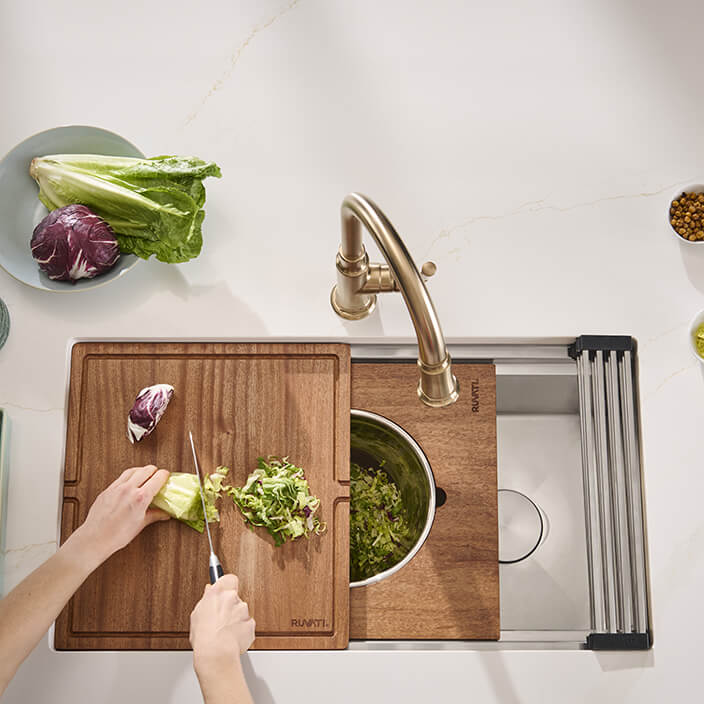
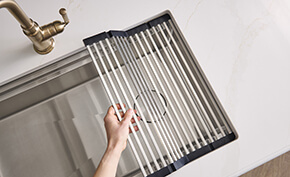
- Integrated workstation ledges for sliding accessories: solid sapele wood cutting board, deep colander, and roll-up drying rack
- Spacious single bowl (33″ x 20″ x 10″) for oversized pots and pans
- EdgeX 10mm radius corners for easy cleaning and a modern look
- Heavy-duty soundproofing and rear drain placement
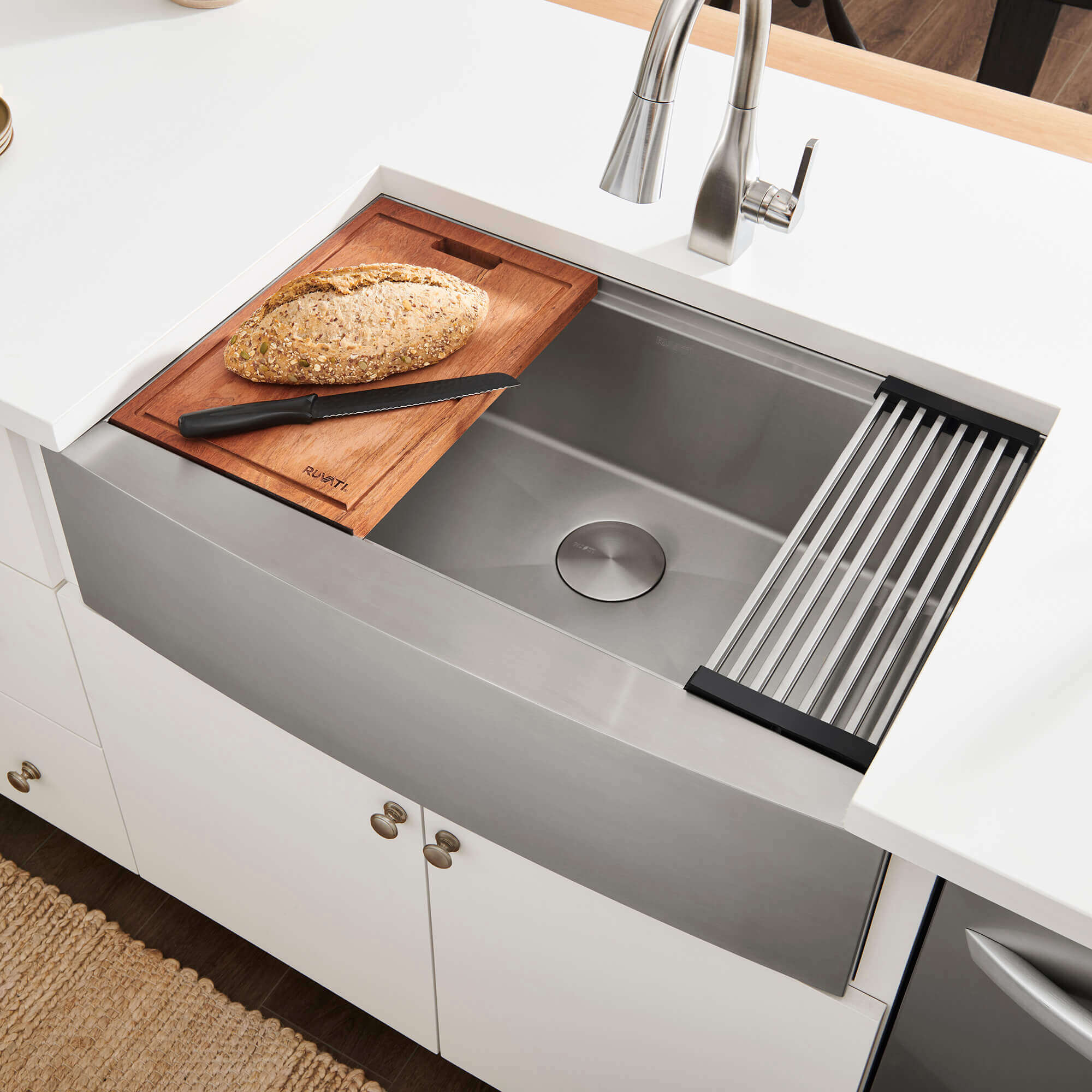
3. Ruvati Verona 36″ Stainless Steel Workstation Farmhouse Sink (RVH9300)
Key Features:
- Extra-large 36″ width and 10″ depth for maximum capacity
- Workstation accessories: sapele wood cutting board, colander, roll-up rack, bottom rinse grid, and drain cover
- 16-gauge T-304 stainless steel for long-lasting durability
- Apron-front design for a bold kitchen statement
- Soundproofing and gently rounded corners for quiet, easy maintenance

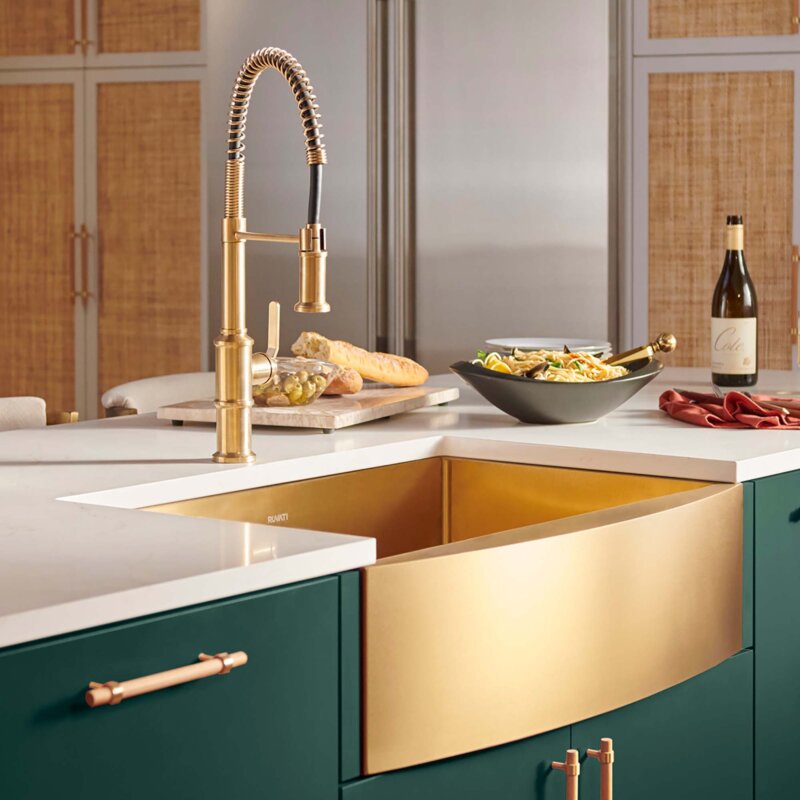
4. Ruvati Terraza 33″ Apron-Front Farmhouse Sink – Brass Tone Matte Gold (RVH9733GG)
Key Features:
- Striking brass tone matte gold finish with nano-PVD technology for superior wear resistance and easy cleaning
- 16-gauge stainless steel construction for strength and longevity
- Single bowl design (33″ x 20″ x 10″) offers ample space for large items
- Apron-front style adds a touch of luxury and sophistication to any kitchen
- Includes matching rinse grid and basket strainer
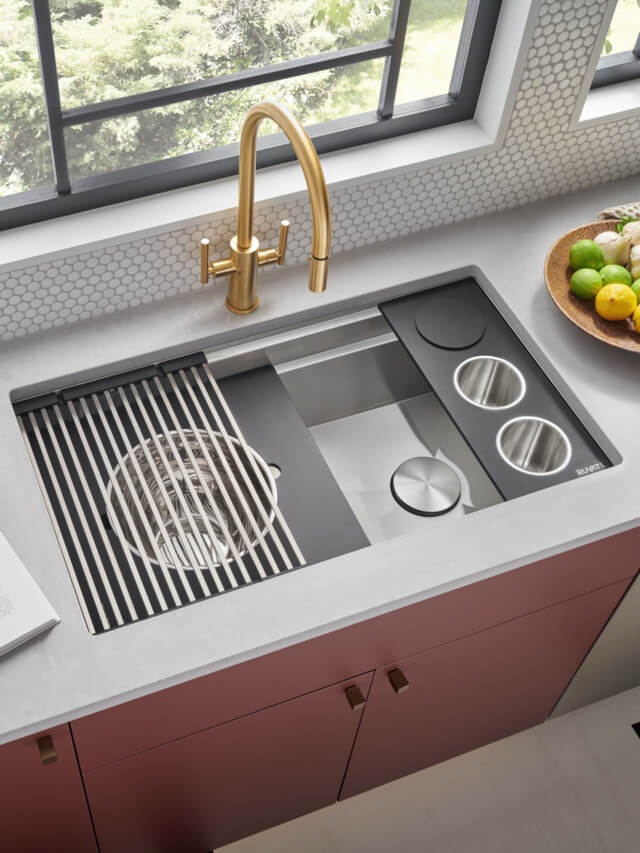
5. Ruvati Dual-Tier Nova 33″ Workstation Farmhouse Sink – Gunmetal Black (RVH8224)
Key Features:
- Dual-tier ledge system for maximum versatility—slide accessories at two levels for prep, wash, and dry
- Nano-PVD gunmetal black stainless-steel finish for a bold, modern look
- Includes solid composite cutting board, roll-up rack, colander, rinse grid, and drain cover
- Spacious single bowl (33″ x 22″ x 10″) for multitasking and entertaining
- Heavy-duty soundproofing and easy-to-clean design
Frequently Asked Questions (FAQs)
Q: What is the best farmhouse sink material?
A: Fireclay is widely regarded as the best farmhouse sink material due to its durability, non-porous surface, and classic appearance. Stainless steel and cast iron are also excellent alternatives, depending on your style and maintenance preferences.
Q: Are farmhouse sinks hard to install?
A: Farmhouse sinks are heavier than standard sinks and often require cabinet modifications or reinforcement, especially for undermount installations. While drop-in (top mount) installation is somewhat simpler, it also requires cabinet/countertop modification.
Q: What are the pros and cons of farmhouse kitchen sinks?
A:
Pros: Extra capacity, ergonomic design, and strong visual appeal.
Cons: Large size, significant weight, and sometimes higher cost compared to traditional sinks.
Q: How do I choose the right farmhouse sink size?
A: Match the sink size to your base cabinet—ideally, the cabinet should be 2–3 inches wider than the sink. Common sink widths include 30”, 33”, and 36”.
Q: What is the history of farmhouse sinks?
A: Farmhouse sinks originated in rural homes before the era of running water. They were designed for washing everything from dishes to clothes, offering a large, practical basin for daily tasks.
Q: Why choose a farmhouse kitchen sink?
A: Farmhouse kitchen sinks combine timeless style with practical features and unmatched versatility. You can choose them for the ease they create for day-to-day kitchen operations and the aesthetic they lend to the kitchen.
Wrapping Up
And with that, our guide on choosing the best farmhouse sink is complete.
There are four main things that you need to consider when buying a farmhouse sink: the material, style, size, and appearance. You should consider your needs and preferences, as well as the sort of usage your kitchen sees and how often you’re able to do a cleaning session. With all of these in mind, you will be able to make an informed decision regarding the best sink choice.
The exact way in which each factor should be measured against your needs has been elaborated above. If you found this article useful, make sure to check the other blogs that we’ve published on our website.