Quick overview: Plastic cutting boards are not safe to use because they can release microplastics in your food.
Plastic utensils should generally be avoided due to their chemically harmful nature. The danger is heightened in cutting boards as they are constantly under sharp impact from knives. This causes them to deteriorate over time, with the microscopic particles finding their way in your food.
There are numerous other alternatives that you can use instead of plastic, such as bamboo and wood. For budget buyers, bamboo is a good choice, while wood is better for those who need quality and durability.
Introduction
Plastic cutting boards can be very appealing due to their low prices and lightweight design. They can be quite easy to use, wash, and store, and don’t require a lot of care and maintenance.
However, with all of these perks and benefits, there is one major downside to plastic cutting boards, due to which they should not be used. They can be harmful to your health because they can leach microplastics into your food.
In this guide, we’ll tell you all about the reality of using plastic cutting boards and some alternatives that you can consider instead.
Why Plastic Cutting Boards Are a Problem
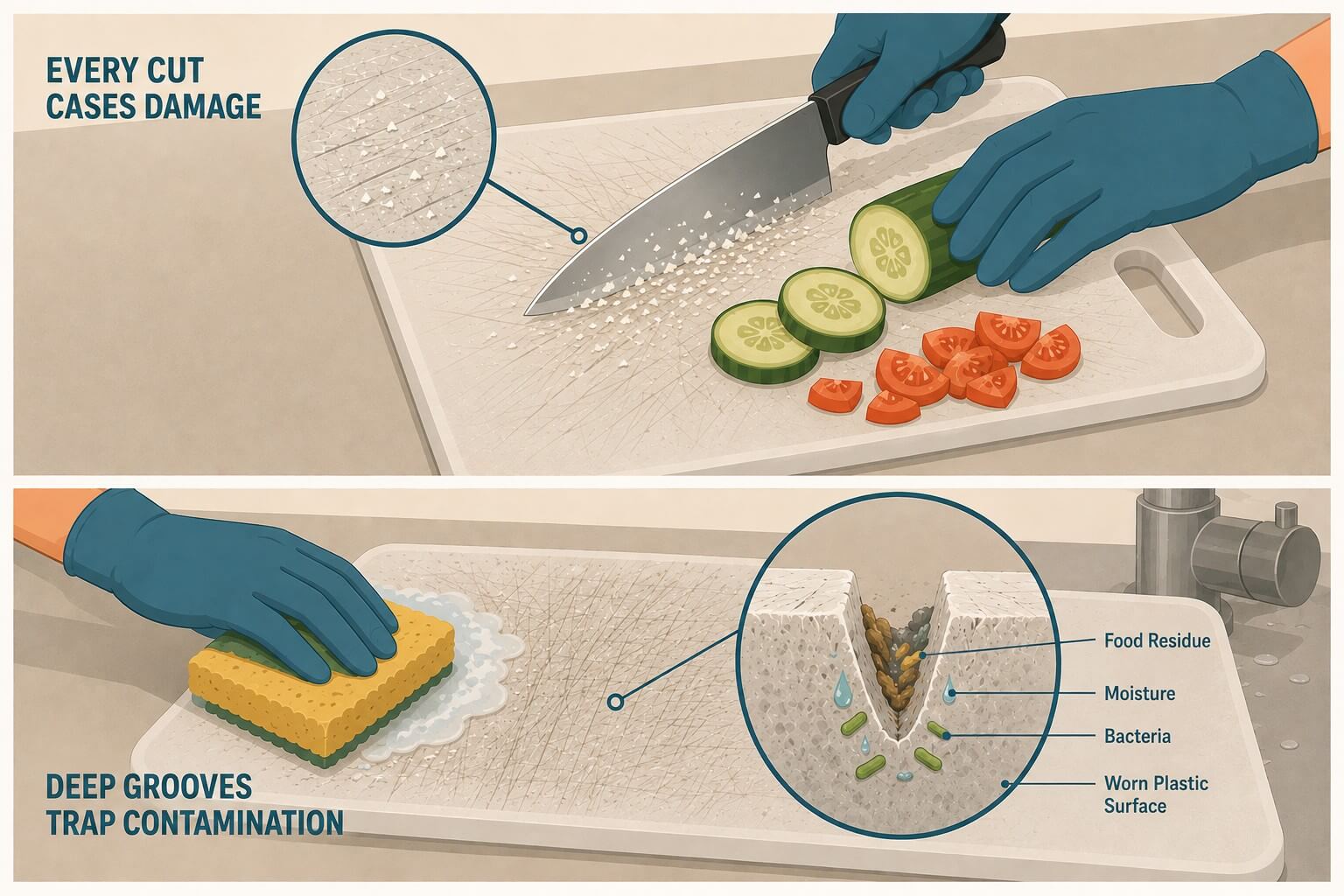
The core issue with plastic cutting boards comes down to what happens every time you use a knife on one. Each cut scores the surface, and over time those scores accumulate into grooves. With every stroke, tiny particles of plastic shear off and mix directly into whatever you are preparing.
This is not a fringe concern. A study published in the journal Environmental Science & Technology found that a single plastic cutting board can shed an estimated 50 grams of microplastic particles per year, roughly the weight of ten credit cards. Here is a link to that study: https://pubmed.ncbi.nlm.nih.gov/37220346/
When boards become heavily grooved and worn, that number climbs into the tens of millions of individual microparticles annually.
The problem is compounded by the fact that plastic is not an inert material. Many plastic products contain chemical additives such as BPA, phthalates, and stabilizers that are introduced during manufacturing. As the surface breaks down under knife pressure, these compounds can leach alongside the physical particles.
The surface that was supposed to be hygienic ends up being the opposite. Deep grooves become difficult to clean properly, creating pockets where bacteria can survive even after washing.
How Bad Is It, Really?
Microplastics have become one of those topics that can start to feel like internet noise. You see the headlines, assume it probably does not apply to you, and move on, especially if you are using a decent quality board.
The health risks are real. Microplastics have been found in human blood and lung tissue. The particles themselves are not harmless once they are in your body, and the chemical additives they carry, such as BPA and phthalates, have been linked to a range of health problems that build up over time. This is not speculative. The evidence has been stacking up consistently across independent studies for years.
That said, not all plastics behave the same way. Boards made from high-density polyethylene (HDPE) are more resistant to degradation than cheaper, lower-grade plastics and will shed less material under the same conditions. A newer board will also release far less than one that has been in use for a couple of years. So the type of plastic and the condition of the board do matter.
But even the better options are still shedding particles into your food. There is no plastic cutting board that stops doing this, and there is no maintenance routine that reverses surface wear. The risks with HDPE are lower, not absent. When materials like wood and bamboo carry none of these risks at all, settling for “less harmful plastic” is a compromise that does not need to be made.
What to Use Instead
The two materials worth considering are bamboo and wood. Both are natural, do not shed microplastics, and hold up well under regular use. The choice between them largely comes down to budget and how demanding your kitchen routine is.
Bamboo is the more affordable of the two. It is technically a grass rather than a wood, which makes it one of the most renewable materials available. Bamboo boards are harder than most wood varieties, which means they resist knife scoring better and tend to last a long time without developing deep grooves. On the downside, that hardness can be slightly tougher on knife edges over time. For most home cooks, bamboo is a practical and cost-effective upgrade from plastic.
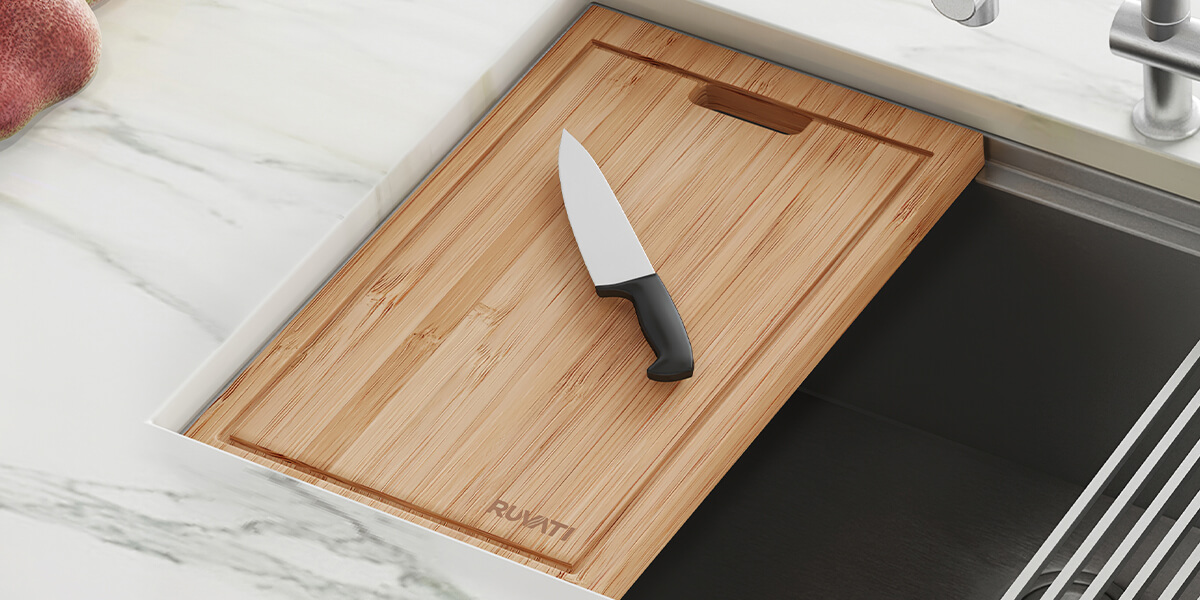
Wood is the better long-term investment. End-grain and edge-grain hardwood boards, typically made from maple, walnut, or teak, are gentler on knives, self-heal minor cuts to some degree, and develop character with age rather than simply wearing out. A quality wood board, properly maintained, can last for decades. The trade-off is cost: a solid hardwood board is a genuine purchase, not an impulse buy.
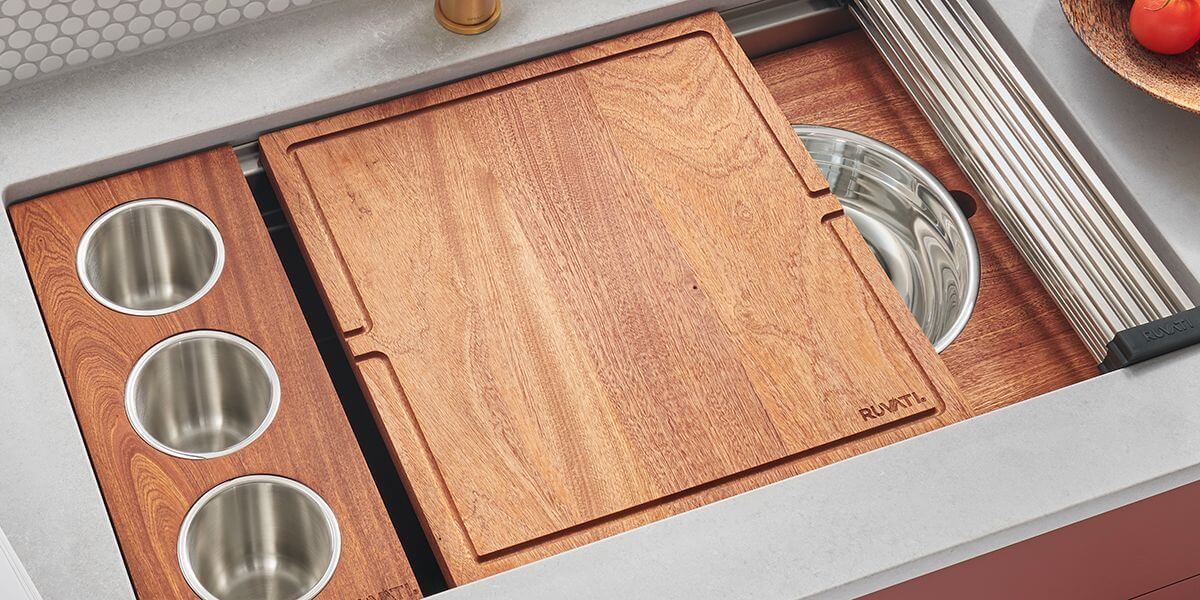
Both materials have one shared requirement: they are not dishwasher safe and need to be hand washed and dried. That is a small adjustment for most people, and one that quickly becomes routine.
How to Care for Wood and Bamboo Boards
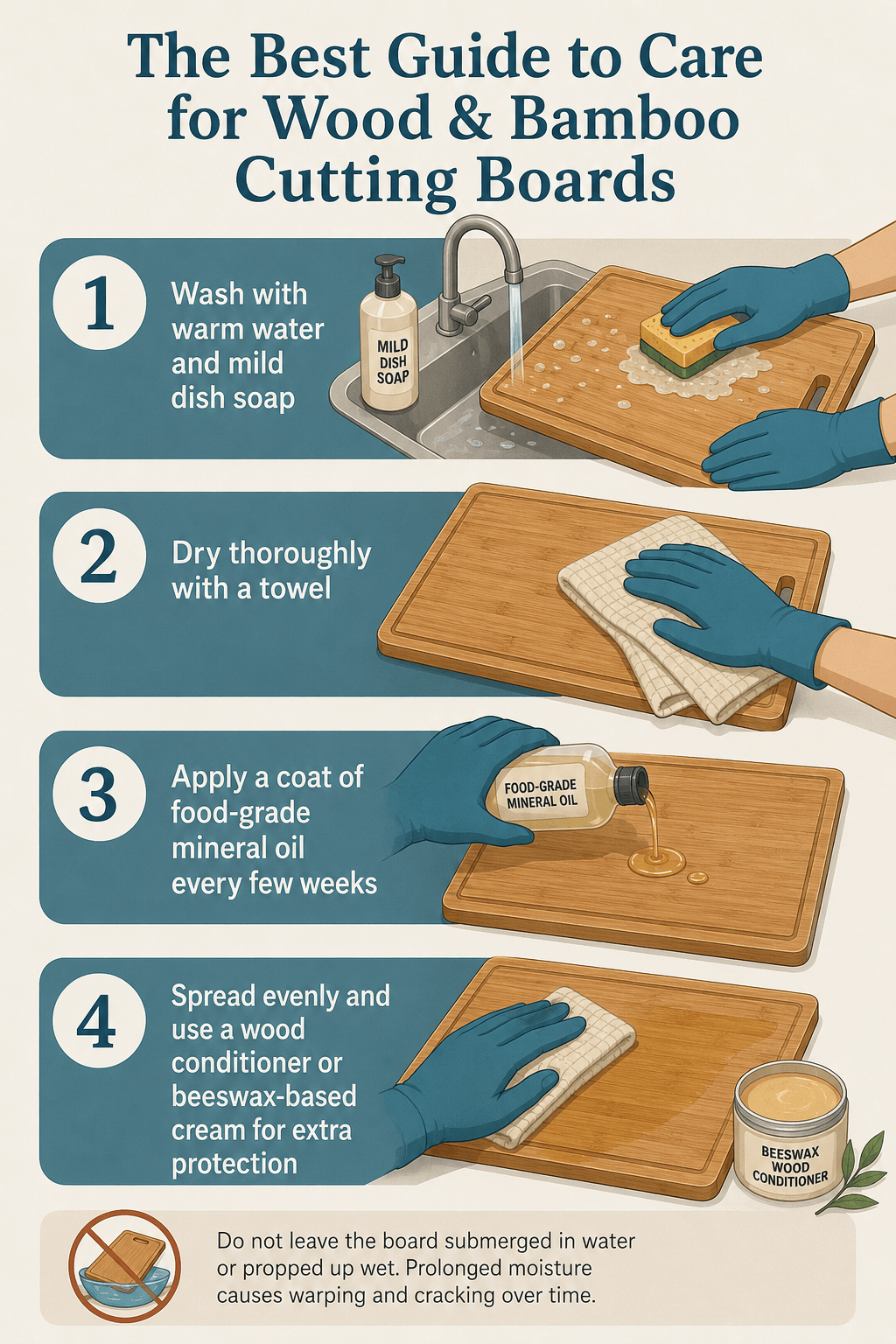
The right care routine makes a significant difference in how long a wood or bamboo board lasts and how well it performs.
After each use, wash the board with warm water and mild dish soap, then dry it thoroughly with a towel. Do not leave it submerged in water or propped up wet, as prolonged moisture causes warping and cracking over time.
Every few weeks, apply a coat of food-grade mineral oil to the surface. This conditions the wood, prevents it from drying out, and keeps the surface sealed. Some boards benefit from a wood conditioner or a beeswax-based cream for added protection.
If you want a cutting board that fits naturally into your kitchen setup, Ruvati makes wood and bamboo cutting boards sized to work seamlessly with their workstation sinks. They slide directly over the sink basin, which keeps prep contained and countertops clear. For anyone already cooking with a Ruvati workstation sink, the boards are a practical addition that holds up to daily use.
Conclusion
Plastic cutting boards have one thing going for them: convenience. They are cheap, light, and easy to find. But that convenience comes at a cost that is easy to overlook until you start thinking about what you are actually adding to your food every time you cook.
Wood and bamboo boards are not dramatically more difficult to own. They require a bit more care, cost more upfront, and need to be hand washed. In exchange, you get a surface that does not contaminate your food, lasts longer with proper maintenance, and holds up better under daily kitchen use. For most people, that is an easy trade.