
Introduction
Here at Ruvati, we sell stainless steel sinks. I mean, it’s not the only thing we sell, but it’s one of the big ones. Since we sell stainless steel sinks, we also know a lot about them, including how to effectively clean them. In this guide, we’ll tell you all about it.
What is the Best and Easiest Method to Clean a Stainless Steel Sink?
Let’s start off with a simple method of cleaning a stainless steel sink that you can follow as a part of your regular routine.
Here is what the method looks like:
Clear the sink and make sure nothing remains in it -> Sprinkle in baking powder -> Rub carefully with a sponge (in the direction of the grain) -> Apply dish soap -> Rub carefully (again in the direction of the grain) -> Rinse with water.
In summation, you’re cleaning the sink with baking soda and dish soap, one after the other.
Here is a list-wise breakdown:
Materials Needed:
- Baking soda
- Soft sponge
- Microfiber cloth
- Dish soap
Steps:
- First, take everything out of the sink and make sure nothing remains in it. Be careful of little bits that can get caught up while you’re brushing afterwards and scratch the surface.
- Once you’re done clearing everything up, turn the faucet on and spray some water around the sink to give it a good rinse.
- Take your baking powder and sprinkle it generously all over the surface.
- Take your sponge and gently brush the sink surface in the direction of the grain. (This means that you should brush in the same direction as the little lines that show up on the steel. If you don’t do this, the surface can get scratched.)
- With the baking powder all rubbed around in a semi-watery paste, drizzle a little bit of dish soap around the sink.
- Take your sponge and rub carefully again, in the same way as before.
- Turn the faucet on and rinse the whole thing thoroughly.
- Dry the sink
This is a standard and easy method to clean your stainless steel sink when you feel that it is getting a bit dirty.
What are Some Usual Everyday Practices to Keep Your Stainless Steel Sink Clean?
As we mentioned above, the cleaning method involving baking soda and dish soap is for times when the sink gets dirty.
Other than that, there are a lot of other things that you can do to make sure that the need for cleaning doesn’t arise as often.
- Rinse and clean your stainless steel sink before and after you use it, and always dry it with a clean cloth.
- Use a bottom-rinse grid with your sink so that there is no direct contact with the base.
- Never let acidic and salty residues dry on the sink’s surface and always clean them off promptly. Otherwise, those residues can leave their marks on the steel.
Specific Problems with Stainless Steel Sinks and How to Fix Them
Okay, so far, we’ve covered how to do some basic cleaning with stainless steel sinks and some general practices that you can follow to make sure that they don’t get too dirty.
Now, let’s take a look at some specific problems that can arise along with how you can take care of them.
- Water spots
- Mineral deposits
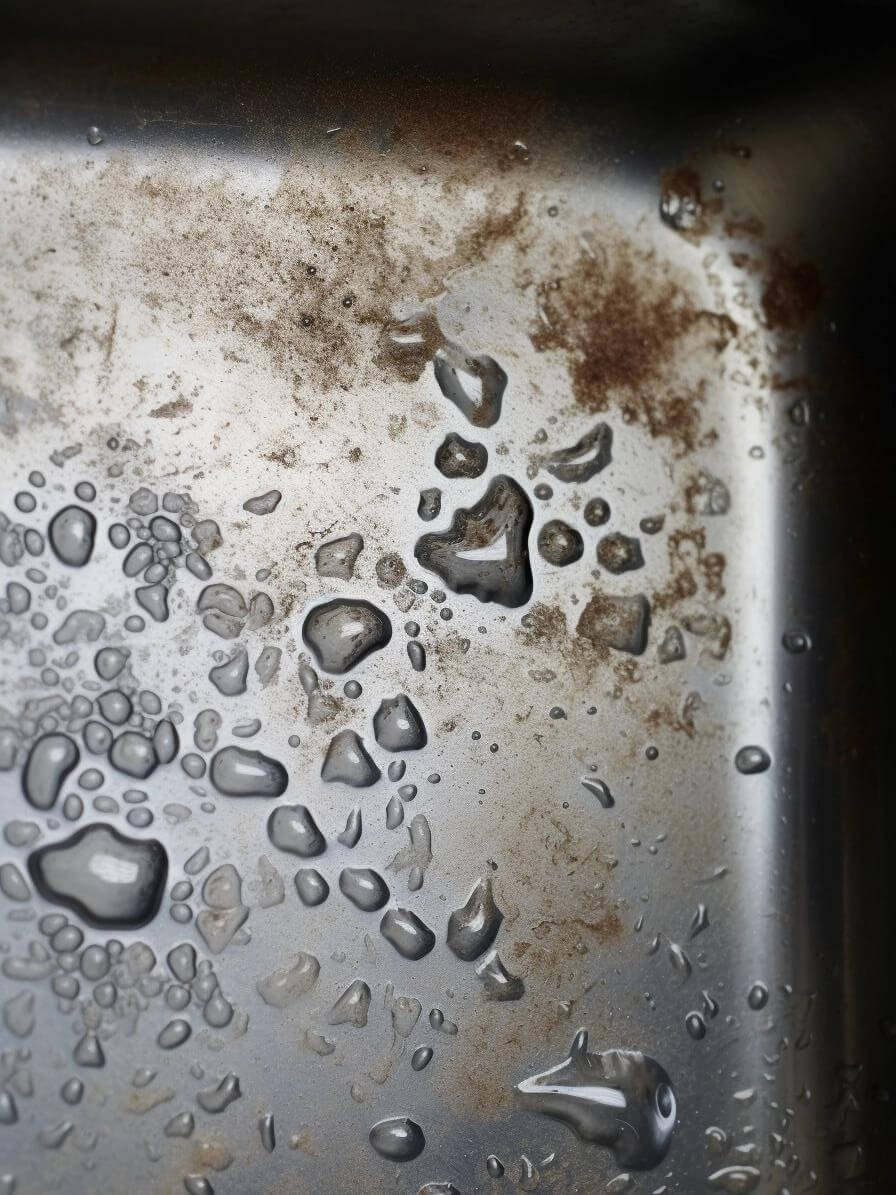
- Rust (which isn’t actually rust)
How to clean water spots from stainless steel sinks?
You can clean water spots from stainless steel sinks with the following methods:
- Make a mixture of equal parts white vinegar and warm water
- Spray that stuff all over the stainless steel surface
- ..
- …keep waiting
- Clean it all off with a microfiber cloth and rinse afterwards
If you don’t have white vinegar (don’t worry; I never have it in my kitchen), you can use lemon juice instead.
How to clean mineral deposits from stainless steel sinks?
For mineral deposits, you also need to use white vinegar.
By the way, before we move on…why exactly white vinegar, you might be wondering? White vinegar is great for cleaning purposes, including for stainless steel sinks, because of its acidic nature. It can dissolve residues and deposits and break down a lot of stuff.
Anyways, coming back to the steps, here is what you need to get rid of mineral deposits:
- Take some white vinegar
- Put it on the affected areas on the sink
- Let it sit for 10 to 15 minutes. Remember, this is not like the routine that we just did above. You have to let the stuff sit before you clean it otherwise, it won’t have enough time to eat through the mineral deposits.
- After waiting for 10 to 15 minutes, scrub the place slowly. You don’t want to do it too fast, but make sure that you put enough pressure that the deposit shifts and budges around.
What about “rust” on stainless steel sinks?
Note the quotation marks. The rust that you find on stainless steel sinks is not exactly rust. When metal items make contact with the sink surface, they leave metallic residue on the latter.
This particular residue catches rust, causing it to appear as if the sink itself is rusting.
To remove these rusty deposits, you can use white vinegar. The steps are similar to what we have mentioned above.
- Clean the sink and rinse it once.
- Apply white vinegar to the rusty parts.
- Let it sit for a while.
- Rub gently with a sponge.
- Rinse everything.
We wrote a full post on how to remove rust on stainless steel sinks that you can check out if you are interested in learning more.
Suggested and Recommended Products for Cleaning Your Stainless Steel Sinks
In the steps and solutions mentioned above, we’ve talked about using different items and chemicals that you can easily find in any home, i.e., vinegar, dish soap, baking powder, and so on.
However, if you want to make the cleaning process easier and more effective, there are dedicated products that you can use instead.
Both of these products are great for cleaning your stainless steel sink. However, they serve slightly different purposes.
Hope’s Perfect cleaner is gentle and non-abrasive, and it’s excellent for cleaning things like water stains, fingerprints, and other minor marks. When used, it leaves behind a thin protective layer that gives the steel surface a gleaming look.
On the other hand, Bar Keeper’s Friend is a stronger and more acidic type of cleaner. It is good for getting rid of stubborn mineral deposits and rust that gentle cleaners can’t deal with.
How Often Should You Clean Your Stainless Steel Sink?
This is the next question that will be on your mind. How often should you clean your stainless steel sink?
- Once a week, you should do the basic cleaning routine using baking soda and white vinegar.
- Once a month, you should do a deep clean using a specialized cleaning product.
- And on a day-to-day basis, you should do the simple rinse-and-dry routine a few times.
One Last Tip to Remember: Don’t Use Harsh Chemicals to Clean Your Stainless Steel Sink
You might have noticed that all the materials and ingredients that we mentioned above are mild and natural, i.e., baking soda, white vinegar, etc.
The cleaning products, such as Bar Keeper’s Friend and Hope’s Perfect are also normal, consumer-grade cleansers. You should not use harsh chemical cleaners as they can affect the appearance of the stainless steel and make your sink unsightly.
FAQs About Stainless Sink Cleaning
Let’s wrap up with some FAQs that will clear any remaining questions that you might have about cleaning stainless steel sinks.
What should I do to clean my stainless steel sink drain?
We’ve written a detailed guide on how to clean your sink drain here on Ruvati. There are a few different methods that you can use, such as pouring boiling water down the drain, using baking soda + salt, or a drain snake.
What should I do if my stainless steel sink is clogged?
If your sink drain is clogged, read our detailed guide on how to unclog a sink. We cover a lot of steps in that guide, such as the boiling water treatment, the plunger treatment, and so on.
Is the cleaning process different for a farmhouse sink compared to a normal one?
For the most part, the cleaning process is the same for a normal sink and a farmhouse sink. A farmhouse sink is typically larger, and it is made of materials like fireclay, which require extra care. You can find more information in our detailed guide on this particular topic.