Article summary/short answer for readers in a rush: Small kitchens work best with sinks that save space, stay practical, and look subtle. Corner, single basin, and compact undermount options fit well without crowding your prep area.
Aim for 22×18 or 24×20 inches, choose a minimalist shape like round or rectangular, and pick low-glare finishes such as brushed stainless or matte composite granite. Keep accessories streamlined, avoid oversized basins, and let the sink support the flow of the room rather than dominate it.
Introduction
A small kitchen is great in so many ways. Even in a luxurious, modern home, a small kitchen makes sense. They’re pleasant to spend time in, they make the whole home look cozy, they’re easy to use, and the list goes on.
However, with all of their benefits, there are some considerations that you need to make when it comes to small kitchens, and one of them is the space constraints.
In this post, we’re going to guide
What Type of Sink Does a Small Kitchen Need?
A small kitchen needs a sink that can fit into the limited space but also provides the necessary features and functions that are needed for day to day tasks.
This is, of course, the general answer. When we start digging a bit deeper, there are a bunch of questions that arise, including:
- What are the “necessary” features and functions that we’re talking about here?
- How do you know that a particular sink can fit into the limited space?
- Which limited space is being referred to here? There are a bunch of them in the kitchen. It could be the corner, the middle, etc.
Moving forward in this post, we’re going to do our best to answer all of these questions. We will tackle the best shapes for a small kitchen, the best sizes, and the best installation styles. Before we get into that, however, we will mention some general kitchen sink ideas that you can go through quickly.
Kitchen Sink Ideas for Compact Spaces
Here is a list of kitchen sink ideas for small spaces. Don’t worry, though. We’ll go into details later on. This list is to give you an overall, general idea.
With that said, here are the ideas:
1. Corner sinks
Corner sinks work great in small kitchens because they can be tucked away right in the corner of the room. They don’t stand out, and they don’t get in the way when you’re trying to work.
What are corner sinks? Corner sinks are sinks designed to fit into a 90-degree corner to maximize counter space. Corner sinks improve kitchen or bathroom layouts by opening usable workspace and reducing congestion in small rooms. Most corner sinks use single-basin or diagonal designs that fit cabinets between 30 and 36 inches wide.
2. Single basin sinks
Another good sink idea for small spaces is a single basin sink. They are excellent because they don’t take up as much room, and can provide the basic functionality that you’d expect in a small kitchen.
What exactly are single basin sinks? Single basin sinks are sinks that use one large, uninterrupted bowl instead of divided compartments. Single basin sinks create more space for washing large pots and pans, and fit standard cabinet widths between 24 and 36 inches.
3. Compact undermount sinks
“Undermount” refers to the method of installation rather than the shape or size of the sink. In an undermount installation, the sink goes below the countertop and doesn’t have a visible lip. This method is great for smaller kitchens as it helps to preserve space on the countertop and make the sink look discreet.
4. Shallow sinks for spots with little depth
Shallow sinks are the sinks in which the bowl is closer to the surface of the countertop. There are a number of perks to these types of sinks, along with some downsides. However, as far as small kitchens go, these sinks can be excellent.
What is the normal depth of kitchen sinks, and what makes a shallow one so? Typical kitchen sink depth ranges from 8–10 inches. Deeper models go 10–12 inches. A sink is considered shallow when it’s 6–7 inches deep (sometimes even less).
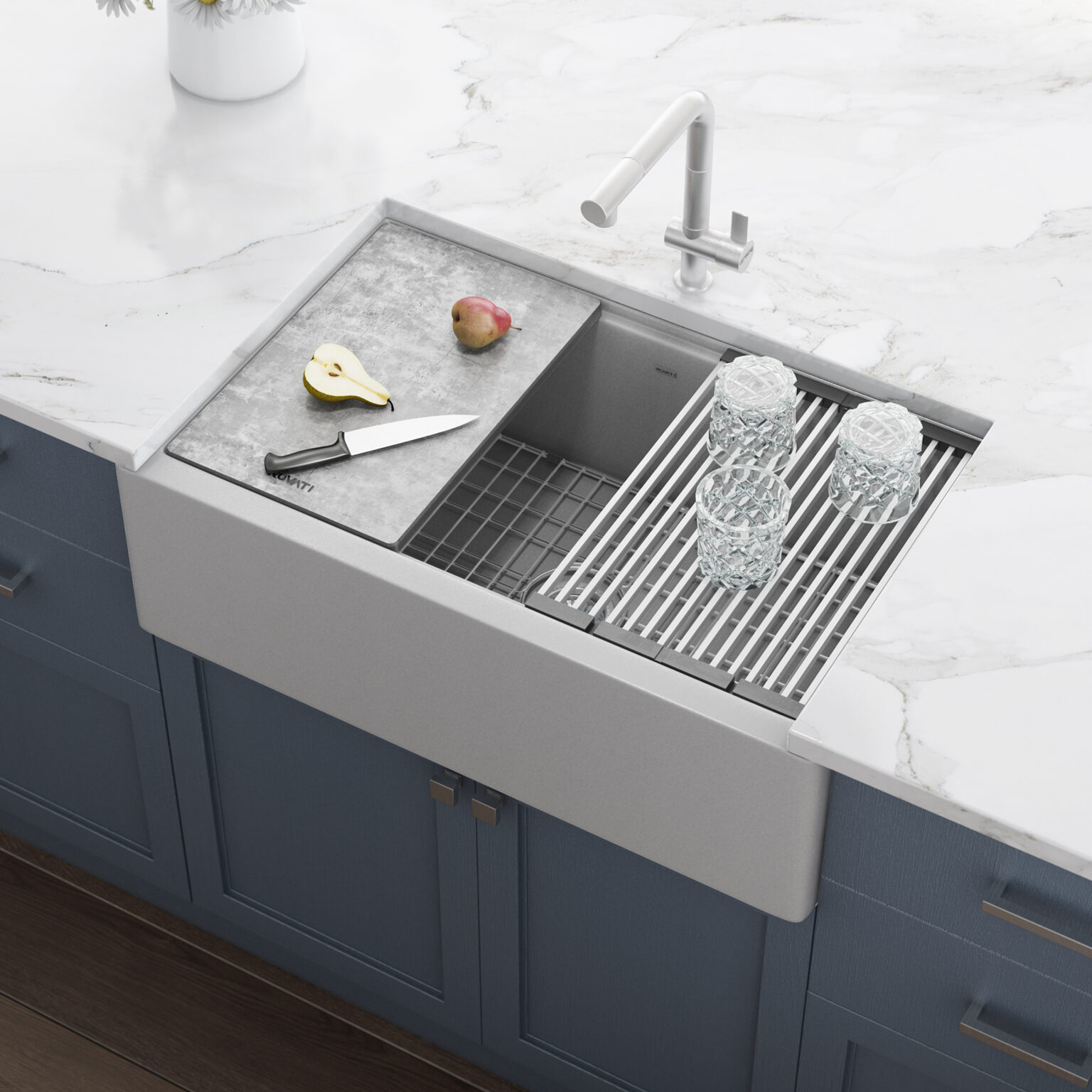
5. Workstation sinks to minimize needed space
A workstation sink includes not just the sink itself, but a number of other accessories. For example, in a workstation sink, you’ll find ridges to fit in a cutting board that you can use over the bowl instead of on the countertop.
Here are some accessories that you can find in a workstation sink:
- Roll-up drying rack
- Cutting board
- Colander
- Drying tray
- Bottom grid
- Drain cover
- Accessories caddy
- Multi-tier rack
- Serving board inserts
Now that we’re done looking at some individual sink ideas for small kitchens, let’s move on to a more general discussion regarding the best sink shapes, sizes, installation styles, and materials/finishes.
Best Sink Shapes for a Small Kitchen
The best sink shapes for a small kitchen are round and rectangular.
Here’s why.
- Rectangular sinks can be fitted in the kitchen without jutting out into the walkway. They can be placed lengthwise against the wall, providing enough real estate to do your washing tasks while also not being a bother during your other kitchen work.
- Round mirrors slip into tight spaces without feeling cramped. Their curved edges soften corners and don’t intrude visually, so even a narrow wall can carry one without looking overstuffed. You get the reflection you need, but the room still feels open
Best Sink Sizes for a Small Kitchen
The best sink sizes for a small kitchen are 22 and 24 inches. The exact measurements that you should get are:
- 22×18 inches
- 24×20 inches
Here is why these two sizes are great for a small kitchen:
| Sink Size | Why It Works in a Small Kitchen |
|---|---|
| 22×18 inches | Compact but capable. Fits tight countertops, handles daily dish load, and keeps movement space clear. |
| 24×20 inches | Adds a bit more room for pots without overwhelming the layout. Efficient, practical, and still space-friendly. |
Best Sink Installation Styles for a Small Kitchen
There are two main installation styles for sinks: undermount and top-mount. Other than these two, other types include vessel sinks and integrated sinks. However, neither of them is good in small places.
Coming back to the undermount and top-mount sinks, both of them are somewhat opposite. In an undermount installation, the lip of the sink is hidden, creating a smooth and minimalist appearance. In a top-mount installation, the lip is visible, but the sink is installed more stably.
Both of them are good for small spaces, depending on the need and situation at hand.
- If you have the budget to afford an undermount sink, it should be your go-to choice. It looks great, and the absence of a sink lip helps to ensure that no grime or crumbs get trapped underneath the same, making maintenance difficult.
- On the other hand, if you are working on a budget, you should go with a top-mount sink. It gets the job done while not creating any problems for the limited space.
Best Sink Materials and Finishes for a Small Kitchen
The material and finish that you choose for your small kitchen sink also have a major impact on how it looks. Ideally, you want to choose a material and finish that makes the sink look subtle, so that the small space is not dominated by it.
Here are some materials that you can go with:
- Stainless Steel (Brushed Finish): With a brushed finish, stainless steel sinks can blend in with the background. They are durable on their own and provide excellent day-to-day usability. With the brushed finish, they play their aesthetic role quite nicely, sitting in the background without overwhelming the space.
- Composite Granite (Matte Finish): The matte surface keeps reflections in check, letting the sink sit quietly in the layout instead of shouting for attention. Built tough, it shrugs off scratches and heat, giving you dependable daily use. Its muted texture adds a grounded, modern look that supports the rest of the kitchen rather than competing with it.
Sink Mistakes to Avoid in a Small Kitchen
Here are some mistakes that you should avoid making in a small kitchen.
- Oversized Basin: Eats up counter space and leaves you nowhere to prep.
- Wrong Depth: Too shallow splashes; too deep steals under-sink storage.
- High-Glare Finish: Reflective surfaces make a small kitchen feel chaotic.
- Perimeter Clutter: Bottles and gadgets around the sink kill workflow.
- Bad Placement: Corners and walkways are no-go zones for daily usability.
Recommended Sinks to Buy for Your Small Kitchen
FAQs
What sink size works best for a small kitchen?
22×18 and 24×20 inches offer good capacity without stealing counter space.
Are undermount sinks better for small kitchens?
Yes. Their flush edges keep the counter looking clean and open.
Is composite granite a good option for tight spaces?
Yes. Its matte finish reduces visual noise, and its durability makes daily use easier.
Should I avoid glossy finishes in a small kitchen?
Yes. Shiny surfaces bounce light around and make the room feel crowded.
What is the biggest sink mistake in a small kitchen?
Choosing a basin that is too large leaves no prep space.
How deep should a sink be in a small kitchen?
Go for a moderate depth that prevents splashing but does not cut into cabinet storage.
Do rectangular sinks fit better in small kitchens?
Usually. They sit neatly against the wall and use the counter width more efficiently.
How do I keep the sink area from feeling cluttered?
Keep only essential items up top and use under-sink storage smartly.
Are integrated or flush-mount sinks worth considering?
Yes. They create a unified surface that makes small kitchens feel more open. However, they typically cost more.
Do faucet choices matter in small kitchens?
Yes. A bulky faucet can overwhelm the area. A compact single-handle faucet keeps things streamlined.